
FHA Loans in Tucson, AZ: Limits, Lenders & How to Qualify
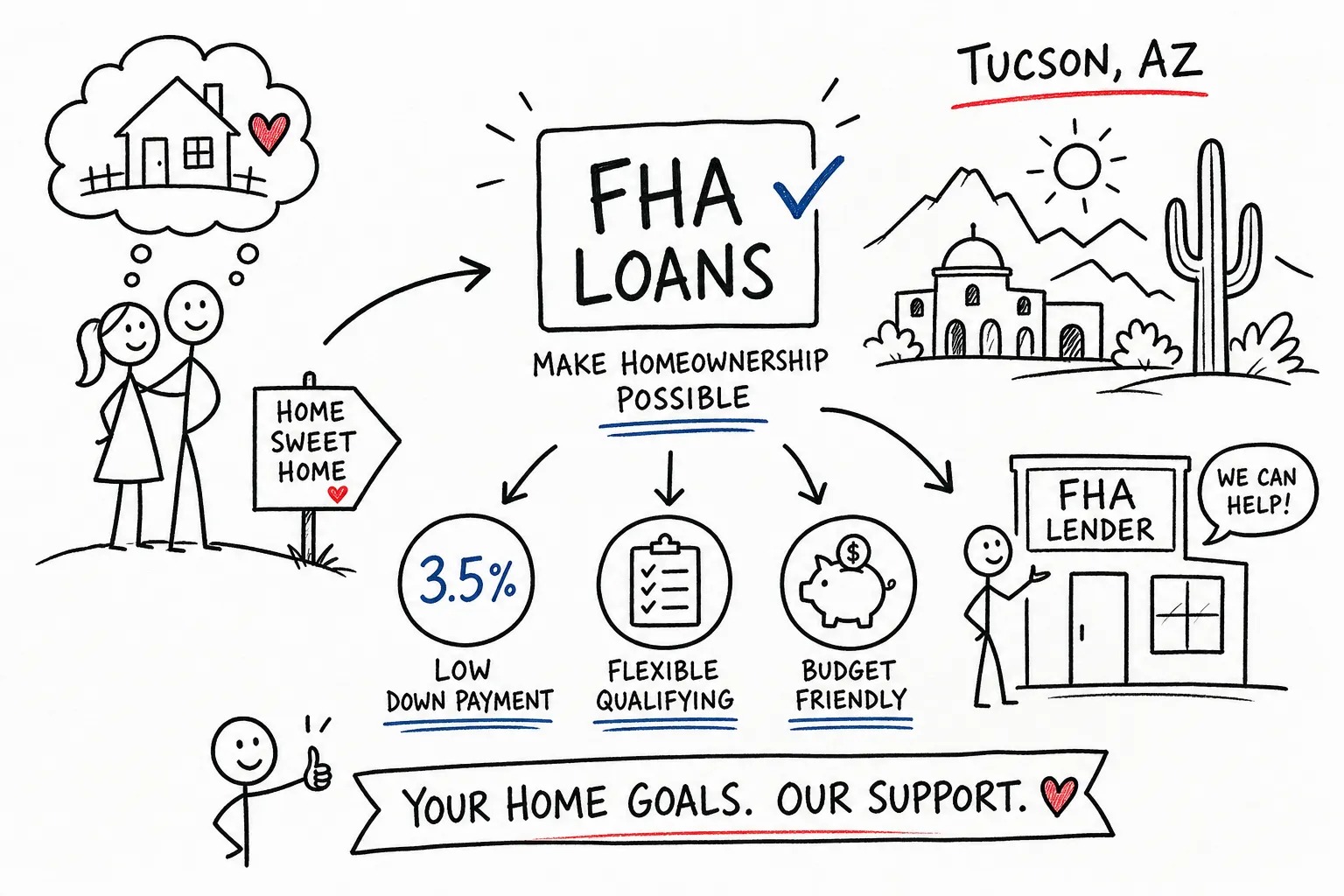
What is the 2026 FHA loan limit in Tucson, AZ? The 2026 FHA loan limit for a single-family home in Pima County is $541,287, with a 3.5% down payment available to buyers with a 580 credit score or higher.
If you're searching for an FHA loan in Tucson, AZ, you're likely dealing with the same reality most local buyers face: rising home prices and conventional loan requirements that make saving a large down payment feel impossible. Some buyers still picture FHA financing as a last-resort option for people with poor credit. That's a misread. FHA is one of the smartest entry points into homeownership in Southern Arizona, especially as home prices in Tucson have risen steadily in recent years and put more pressure on buyers who haven't had time to build substantial savings.
What makes FHA particularly useful here is that Pima County has its own loan limits, and several local and state programs can layer on top of FHA to dramatically reduce, or in some cases nearly eliminate, the down payment requirement. The rules aren't complicated, but they are specific. Generic national FHA guides won't tell you what the Pima County ceiling is, which local assistance programs are active right now, or what kind of credit profile actually gets approved in 2026. This guide covers all of it.
I'm Jon Harned with EPIQUE Realty, and I work with Tucson buyers on FHA purchases regularly, connecting clients with local lenders who know this market and these programs well. Here's what you need to know before you start the preapproval process.
What Tucson's 2026 FHA loan limits mean for your purchase price
The 2026 FHA loan limit for a single-family home in Pima County is $541,287. That's the maximum loan amount HUD will insure in this county, not the maximum purchase price. If you bring a larger down payment to the table, you can technically purchase above that ceiling; the limit applies to what gets insured, not what you pay. This number resets annually, and the 2026 figure reflects the upward pressure Tucson's home values have placed on the county's baseline.
For buyers considering a multi-unit property, the limits scale up significantly. A duplex in Tucson carries a 2026 FHA limit of $693,050, a triplex sits at $837,700, and a four-unit property reaches $1,041,125. These numbers open up a real opportunity for buyers interested in house-hacking: purchase a duplex or triplex with an FHA loan, live in one unit, and use rental income from the others to offset your monthly payment. Many buyers pursue this strategy in Tucson when local rental conditions support it, confirm current vacancy rates and rental demand with a local real estate professional before counting on that income.
How Pima County FHA loan limits compare to other Arizona counties
Not every Arizona county shares the same limit. Pima County sits at the national FHA baseline floor of $541,287, which it shares with many standard-cost counties across the country. High-cost metro areas like Maricopa County (Phoenix) and Coconino County (Flagstaff) carry higher limits. This matters if you're relocating from Phoenix and expect the same ceiling to follow you south. In Tucson, you're working with the baseline, which, for most price points in this market, still provides plenty of room.
Credit scores, down payments, and DTI: what FHA lenders in Tucson actually require
The FHA's official minimum credit score is 500, but that's the technical floor, not the threshold most lenders actually use. The number that matters in practice is 580. That's the score that unlocks the 3.5% down payment option, which is the core reason most buyers choose this program over conventional. Buyers with scores between 500 and 579 can still qualify under FHA guidelines, but they'll face a 10% down payment requirement, which significantly shrinks the financial advantage.
Debt-to-income ratio follows a similar pattern. The standard benchmark is 43%, but lenders have flexibility to approve higher DTIs when compensating factors are present. Those factors include strong cash reserves, a lower housing-payment ratio relative to income, or a longer history of on-time payments. If your DTI runs above 43%, don't assume you're out. A lender who knows how to structure your file can make a higher ratio workable.
The 3.5% down rule in real dollar terms
On a $350,000 home in Tucson, a 3.5% down payment is $12,250. Compare that to what conventional loans typically require, often 5% to 20%, depending on the program and lender, though some specialty conventional products allow as little as 3%, and the difference is immediate and concrete. For a first-time buyer saving while paying Tucson's rental prices, $12,250 is reachable in a way that $35,000 or $70,000 simply isn't. That gap is exactly why this financing option makes strategic sense for buyers entering this market.
FHA vs. VA vs. conventional: choosing the right loan in Tucson
The clearest rule of thumb: if you're an eligible veteran, active-duty service member, or surviving spouse buying in the Tucson area, a VA loan almost always beats FHA on cost. VA loans carry no down payment requirement and no ongoing mortgage insurance, though they do include a funding fee, which can be waived for qualifying disabled veterans. If you qualify for VA, exhaust that option before looking at FHA. I work with military clients and buyers connected to Fort Huachuca regularly, and VA is typically the right starting point for eligible buyers.
For buyers without VA eligibility, the FHA versus conventional comparison comes down to your credit score and how long you plan to stay in the home. FHA wins for buyers with credit scores below 680, smaller down payments, and higher DTI ratios. At 620 credit, conventional PMI can run $355 to $465 per month on a $300,000 loan, while FHA's annual MIP works out to roughly $138 on the same loan size. That's a meaningful monthly difference.
When to reconsider FHA and look at other options
FHA isn't the right fit for every buyer. If your credit score is above 720 and you're putting down 20% or more, conventional financing will likely cost you less over time. Conventional PMI can be canceled once you reach 20% equity; FHA mortgage insurance, with less than 10% down, stays for the life of the loan. Buyers with strong credit and solid savings should run both scenarios side by side before committing. A good lender will do this math for you without pressure.
Down payment assistance programs that pair with FHA financing in Tucson
FHA's 3.5% down requirement is already manageable, but several programs in Tucson and across Arizona can reduce that cost further. In some cases, buyers can close with little to nothing out of pocket for the down payment. These programs aren't hidden or complicated, but they do require a lender who knows which ones are currently active and how to structure the loan correctly.
The Pima Tucson Homebuyer's Solution Program
The Pima Tucson Homebuyer's Solution, or PTHS, is the most directly relevant program for Pima County buyers using FHA financing. It explicitly lists FHA as an eligible loan type and provides down payment and closing cost assistance through a forgivable second mortgage. To qualify, buyers need a minimum 640 credit score, a DTI no higher than 45%, and they must complete a homebuyer education course. The income limit for FHA borrowers through PTHS is $146,503 for household income, which captures a wide range of Tucson buyers. The program is not restricted to first-time buyers, which is a meaningful distinction. Check the PTHS program page directly for current funding availability and any updates to eligibility thresholds.
Arizona Home Plus and other statewide options
The Arizona Home Plus program, often listed as Home+Plus, is a statewide alternative that also layers with FHA financing. It provides assistance for both down payment and closing costs and is available across Pima County. Family Housing Resources and the City of Tucson's own down payment assistance program are additional channels worth exploring depending on your income and purchase location. Program rules shift, income limits update, and funding availability changes, which is why working with a lender who stays current on these programs is essential. I keep a network of local lenders who know which programs are funded and open right now, not what was available six months ago.
What FHA mortgage insurance actually adds to your Tucson payment
FHA mortgage insurance catches many buyers off guard at closing, not because it's hidden, but because it gets glossed over in early conversations. There are two components: an upfront MIP of 1.75% of the loan amount, which is typically financed into the loan balance, and an annual MIP paid monthly. For most 30-year FHA loans with a low down payment, that annual rate runs around 0.55%.
In concrete terms, on a $300,000 loan in Tucson, monthly MIP adds about $138 to your payment. On a $540,000 loan, near Pima County's FHA ceiling, it adds approximately $248 per month. These aren't small numbers, and they need to be part of your budget before you commit to a specific purchase price. Add those figures to principal, interest, property taxes, homeowners insurance, and any HOA dues, and you'll have a realistic picture of what you're actually committing to each month.
How long MIP lasts and when it goes away
With less than 10% down, FHA mortgage insurance stays for the full life of the loan. This is the key structural difference between FHA and conventional: conventional PMI can be canceled once you build 20% equity, but FHA MIP doesn't automatically drop for low-down-payment loans. Buyers who plan to stay in a home for 10 or more years should factor this cost into their long-term comparison. Those who anticipate refinancing within a few years, once their equity or credit score improves, should understand that refinancing into a conventional loan is the standard path to removing MIP permanently.
How to get preapproved for an FHA loan in Tucson, AZ: a step-by-step guide
Preapproval is where research turns into action. The process isn't complicated, but having everything ready before you contact a lender speeds things up considerably and gives you a stronger position when you're ready to make an offer. Understanding your full cost picture before you start shopping is worth the time it takes to pull your documents together.
Here's the step-by-step path from initial qualification check to preapproval letter: check your credit report and pull it yourself before a lender does, so you can catch errors and dispute anything that might drag your score down unnecessarily; gather your income documents, typically two years of tax returns and W-2s, your two most recent pay stubs, and bank statements covering at least two months, confirming specifics with your lender since requirements can vary; list your existing debts, including car loans, student loans, credit card balances, and any other monthly obligations that factor into your DTI calculation; identify which assistance programs apply, confirming your income and credit eligibility for PTHS or Arizona Home Plus before you apply so your lender can structure the loan accordingly from the start; and apply with a lender who specializes in FHA, since not all lenders handle these loans equally, some have overlays, internal standards stricter than the FHA minimums, while others are optimized for it.
Working with a Tucson lender who knows FHA inside and out
Lender selection matters more than most buyers realize. A lender with strict overlays might decline a file that another lender approves without hesitation, even with the same FHA backing. The difference is experience and program access. I connect Tucson buyers with local lenders who specialize in FHA financing, including the down payment assistance programs unique to Pima County, so you don't have to spend time researching lender by lender or hoping you end up with someone who understands how PTHS stacks with an FHA loan. That groundwork is already done.
Frequently asked questions
What credit score do I need for an FHA loan in Tucson?
The FHA's official minimum is 500, but 580 is the practical threshold that unlocks the 3.5% down payment option. Scores between 500 and 579 require a 10% down payment instead.
How much is the FHA loan limit for a duplex in Tucson?
The 2026 FHA limit for a two-unit property in Pima County is $693,050, with a triplex at $837,700 and a four-unit property at $1,041,125.
Can I combine down payment assistance with an FHA loan in Tucson?
Yes. Programs like the Pima Tucson Homebuyer's Solution and Arizona Home Plus both list FHA as an eligible loan type and can significantly reduce or eliminate your out-of-pocket down payment.
Ready to start? Here's your next step
You now have what most buyers spend weeks trying to piece together: the 2026 Pima County FHA limits, the credit and income thresholds that actually matter, the local programs that can cover your down payment, and a clear picture of what MIP adds to your monthly cost. FHA financing in Tucson isn't a fallback. For buyers who don't have 20% saved and don't have VA eligibility, it's often the most direct, cost-effective path to buying a home in this market.
The next step is a conversation with a lender who can run your actual numbers and tell you exactly what you qualify for.
Wondering what you'd actually qualify for on an FHA loan in Tucson? Text me at (520) 675-1240 your rough credit score and target price range and I'll connect you with the right local lender to run your numbers, no obligation.
Jon Harned EPIQUE Realty (520) 675-1240 | jonharned@epique.me
Categories
Recent Posts





GET MORE INFORMATION