
Hiring a Realtor in Tucson: A Complete Guide for 2026
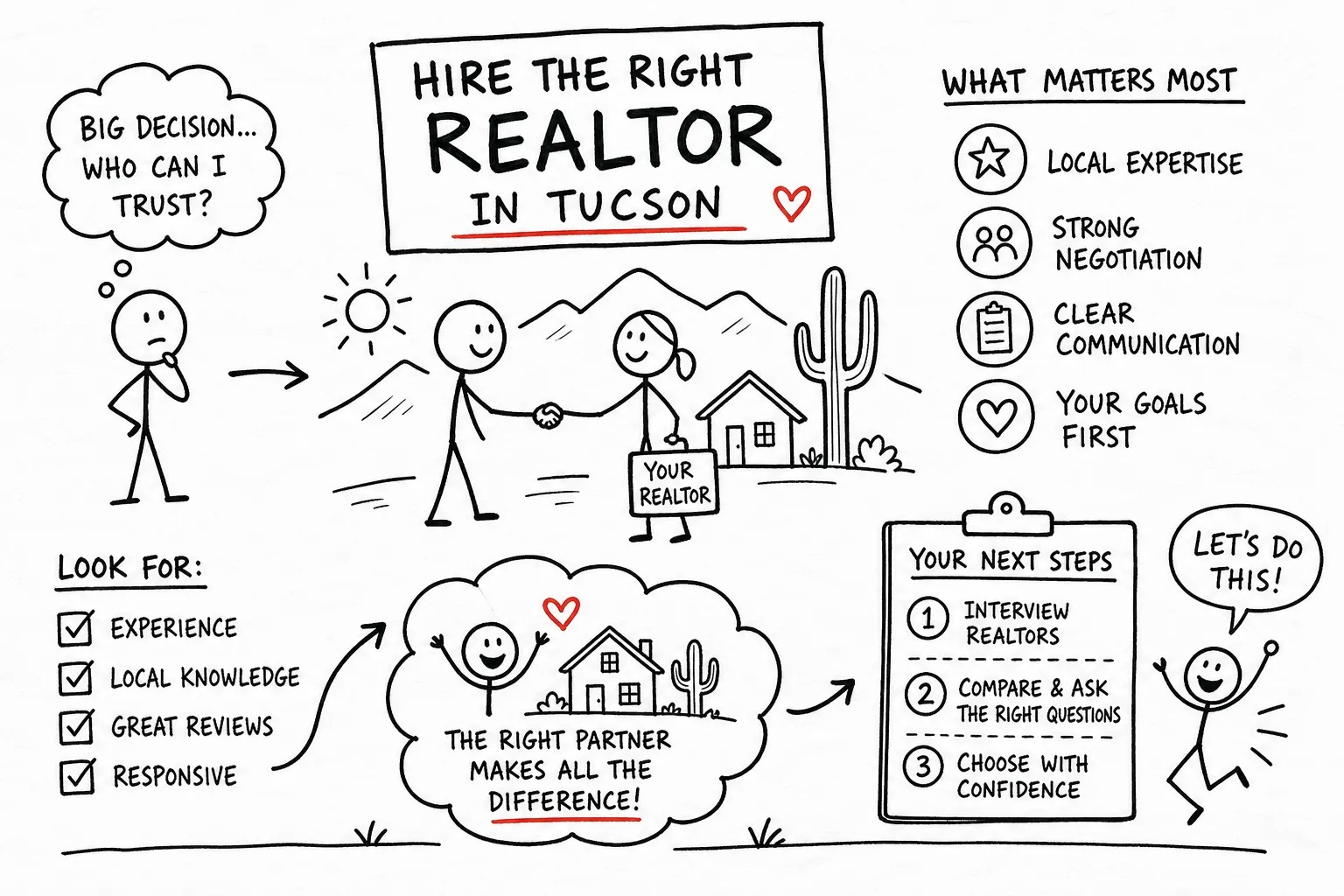
Hiring a realtor in Tucson looks straightforward until you realize how differently each corner of the city behaves. Green Valley and Saddlebrooke serve a retirement-community buyer pool with specific HOA expectations and lifestyle priorities. The Catalina Foothills demand high-end negotiation skills and familiarity with custom-home inventory. Marana is a new-construction submarket with its own builder contract quirks and appreciation curves. Rita Ranch draws first-time buyers on tight budgets. An observable number of listings across the city also involve probate and estate sales, a reflection of the region's large and aging retiree population. The wrong agent in this environment can cost you thousands of dollars and weeks of avoidable stress.
The best agents working in Southern Arizona share several key traits: deep neighborhood-level knowledge, a documented performance track record, and credentials that reflect genuine specialization. This guide walks you through every step of finding, vetting, and choosing the right Tucson real estate agent for your deal.
Why your agent choice carries more weight in Tucson than most markets
Tucson has its own rhythm, and it's easy for out-of-area or part-time agents to miss it entirely. Listing activity tends to pick up in late winter and spring as snowbirds wrap up relocation decisions and retirees move before summer heat settles in, a pattern local agents know well from experience, even if the exact numbers shift year to year. The University of Arizona keeps rental demand elevated in specific zip codes, which directly affects pricing and investor competition in neighborhoods like Sam Hughes and Blenman-Elm. Desert-specific variables like lot size, mountain views, and HOA structures add pricing layers that generalists routinely undervalue or overstate.
Neighborhoods don't behave uniformly, either. A Catalina Foothills buyer needs an agent with genuine luxury negotiation experience. A Marana buyer needs someone who understands builder contracts and the infrastructure commitments tied to new developments. A Sam Hughes buyer needs an agent who can distinguish between historic-home quirks that affect financing and ones that don't. Matching your agent to your specific neighborhood is one of the most important controllable factors in how your transaction performs, and it's a decision you make before the deal even begins.
A meaningful portion of Tucson's inventory also involves inherited or estate-owned properties, driven by the region's large and aging retiree population. These transactions require legal knowledge, timeline management, and coordination with attorneys and probate courts that many agents aren't equipped to handle. If your transaction touches an estate, that specific capability should be at the top of your checklist before you ever reach the interview stage.
Hiring a Realtor in Tucson: Credentials and Track Record That Actually Matter
Start with ranking. In Tucson's MLS, a Top 1% designation means the agent has consistently delivered closed sales volume that outperforms 99% of all licensed agents in the region. That's not a marketing claim, it's a data point tied to the public MLS record. When you're interviewing candidates, ask directly: "Where does your closed sales volume put you in the Tucson MLS, and can you show me your closed transactions in the past 12 months within my price range?"
Verify every agent through the Arizona Department of Real Estate's Public Database at services.azre.gov. No login is required. Enter the agent's name, pull their license record, and you'll see their license status, expiration date, employment history, continuing education compliance, and any complaints or disciplinary actions on file, a process that takes under five minutes. Zillow profiles and agent websites are marketing materials; the ADRE database is the official record and the only source worth trusting for verification.
For track record, the numbers that matter most when evaluating a listing agent are the list-price-to-sold-price ratio, average days on market compared to the neighborhood benchmark, and closed volume within your price range in the current year. Top Tucson listing agents are consistently hitting 97 to 98%+ on their list-to-sold ratio, while the market-wide average sits at about 96.63% (per June 2026 MLS data). An agent who can't produce this data on request during an interview is not an agent you should hire.
On review platforms like Google and Zillow, the most revealing feedback describes specific challenges, a competitive multiple-offer situation or a probate delay, and explains how the agent responded. Ask agents directly for two or three references from past clients with a similar transaction type and neighborhood, then actually call them.
What to expect from realtor fees in Tucson in 2026
The typical total commission in Tucson runs around 5.82%, split roughly equally between the listing agent and the Tucson buyer's agent. On a home priced near the current single-family median, that works out to approximately $29,700 on a $510,000 sale, around $14,550 on a $250,000 home, and roughly $49,470 on an $850,000 property.
Sellers traditionally pay the total commission at closing. Post-NAR settlement rules have since given buyers more flexibility in how their agent's fee is structured, disclosed, and negotiated.
Before signing any listing agreement, get direct answers to these questions: Is the commission rate negotiable? What does it specifically cover, photography, staging, virtual tours, open houses, social media? What are the cancellation terms if the relationship stops working? A confident, experienced agent will answer all of them without hesitation. Vague responses about cancellation terms are a signal worth taking seriously before you commit to anything in writing.
The interview questions that reveal strategy, not just personality
For a listing agent, the most useful questions focus on pricing logic and marketing specifics. Ask how they determined your list price and which comparables they used. Ask for their average list-to-sale ratio and average days on market for the past six months in your neighborhood. Get their complete marketing plan in writing, professional photography, virtual tours, social media placement, and open house strategy. Then ask the question most sellers skip: "What could prevent this home from selling, and what's your plan if we don't see strong activity in the first two weeks?" An agent who deflects that question or offers only reassurances isn't giving you the strategic partnership you need.
For a Tucson buyer's agent, the questions shift toward market intelligence and offer strategy. Ask how many individual transactions they've personally closed in your target neighborhoods in the past twelve months. Ask how they approach competitive offers in a market where well-priced homes are going under contract at a median of 29 days on market (June 2026). Ask whether they work exclusively with buyers or divide their time between buyers and sellers. Before you commit to any representation, ask to review the buyer's agreement in full. Any agent who resists giving you time to read the agreement before signing is not the right agent.
Red flags to watch for and how to make your final call with confidence
Clear warning signs include agents who avoid direct answers about your property's specific risks, agents who can't produce a track record on request, and anyone who pressures you to sign without time for review. Part-time status is another flag, especially when obscured behind vague language about "flexibility." In Tucson's 2026 market, where homes are averaging 52 days on market before going under contract, you need an agent who is fully present and proactive, not one splitting attention across multiple markets or side careers. Also flag any agent with no active presence in your specific neighborhood over the past 12 months; local knowledge goes stale quickly in Tucson's evolving submarkets.
To make a confident final decision, interview two or more agents and compare their answers on strategy and track record rather than personality. Verify every license on the ADRE database. Ask for references from recent clients with a similar transaction type and actually call them. The right Tucson real estate agent isn't just competent in a general sense, they're the right match for your specific neighborhood, price point, and transaction complexity.
Ready to move forward? Start with the right local expert
Tucson's layered market rewards buyers and sellers who hire someone with deep roots in Southern Arizona, not a generalist working across the whole state. When hiring a realtor in Tucson, verify credentials through the ADRE database, compare track records, ask interview questions that reveal strategy, and match your agent to your specific neighborhood and transaction type before you sign anything.
If you're ready to take the next step, reach out to me on win3team.com for a free consultation or a free home valuation. Whether you're buying your first home in Rita Ranch, selling a property in the Catalina Foothills, or navigating a probate sale on behalf of an estate, I bring local expertise across Tucson, Vail, Rita Ranch, Rancho Valencia, Sahuarita, Green Valley, and Tanque Verde to make every stage of the process faster, clearer, and more confident.
Categories
Recent Posts

GET MORE INFORMATION