
Moving to Tucson from Phoenix: What No One Tells You
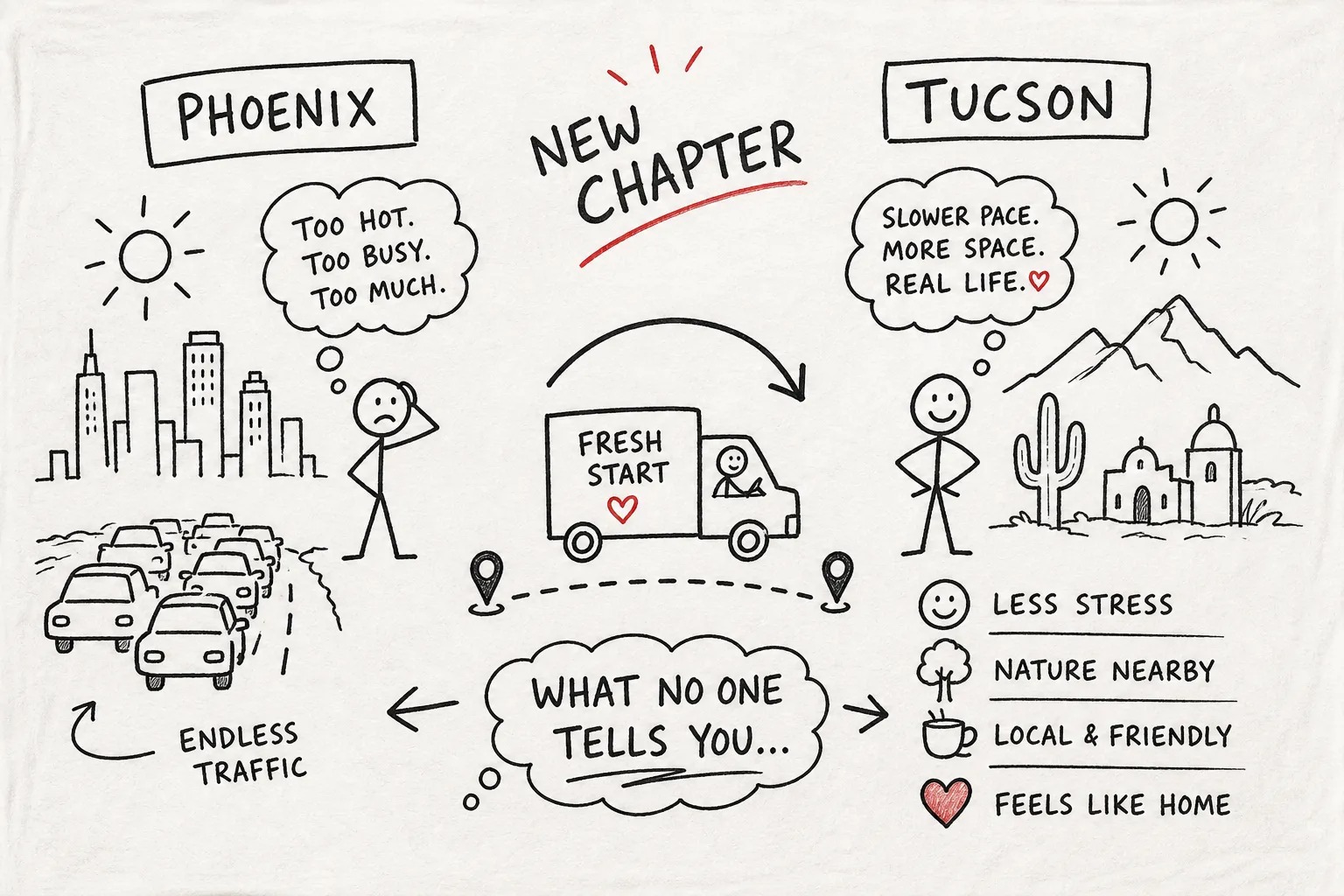
If you're moving to Tucson from Phoenix, the first thing you should know is that this isn't just a lateral relocation, it's a genuine lifestyle shift. Phoenix is a great city. The jobs, the sports teams, the restaurant scene all deliver. But somewhere around your fifth consecutive summer of 115-degree afternoons, sky-high rent, and another chain restaurant opening where a local spot used to be, a thought starts creeping in: what if there's a better version of Arizona, just down the road? For a growing number of Phoenicians, that answer is 115 miles south on I-10.
This guide is built from real Phoenix-to-Tucson relocation experience, not a generic moving checklist. I'm a Tucson Realtor with the WIN3 Team at EPIQUE Realty, and I've walked Phoenix-area buyers through this exact transition. The questions I hear most often aren't about square footage or interest rates. They're about what actually changes when you make the move: what costs less, what you'll miss, which neighborhoods actually fit your life, and what paperwork you need to knock out in your first 30 days. Here's everything you need to know before you go.
The real cost difference: what your money actually buys in Tucson
One of the biggest surprises for anyone making the Phoenix vs. Tucson comparison is just how far the cost-of-living gap extends. Based on widely used cost-of-living index data, Tucson runs roughly 4 to 5% less expensive than Phoenix on a blended basis, and considerably more in the categories that matter most to homebuyers and renters. That gap sounds modest until you see where it actually shows up in your monthly budget.
Housing: where the real savings stack up
The average home purchase price in Phoenix sits around $607,000. Tucson's median eased to $375,000 as of April 2026 (per local MLS data), giving buyers considerably more negotiating power right now. For renters, the gap is even more dramatic: a standard house rents for roughly $1,276/month in Phoenix versus $1,002 in Tucson. Townhome renters face an even starker comparison, with Phoenix averaging $1,519/month against Tucson's $882. That's a 72% difference.
What does that mean in practice? At current mortgage rates, a buyer putting 10% down on a $450,000 Tucson home would see a monthly payment comparable to financing a significantly less expensive Phoenix property under the same terms, meaning that Tucson budget buys you considerably more square footage, a newer build, or a more desirable zip code. Running the numbers through a mortgage calculator with your actual rate and insurance estimates will give you the clearest picture for your situation.
Utilities, transportation, and everyday expenses
Energy costs run about $231/month in Tucson versus $245 in Phoenix, a roughly 6% savings that adds up over Arizona's long cooling season. Gas prices tend to run around 10 to 12% lower in Tucson than in Phoenix, and vehicle maintenance costs noticeably less too. Tire balancing, for example, typically runs meaningfully lower in Tucson than in the Phoenix metro.
There is one honest trade-off worth flagging: groceries are actually about 0.8% cheaper in Phoenix. It's a minor line item, but it's real, and a move south doesn't fix everything.
The income equivalence math
For remote workers and dual-income households doing the numbers, here's the most useful framing: a $60,000 salary in Phoenix carries roughly the same purchasing power as approximately $53,648 in Tucson, meaning your dollar stretches further there. If your employer lets you keep your Phoenix salary when you relocate south, you're effectively giving yourself a raise without a single negotiation. The exact figure will vary depending on which cost-of-living dataset you use, but the directional advantage is consistent across sources.
What Phoenix transplants are always surprised to discover
Cost is the logical case for moving. But Tucson's personality is what makes people stay. And it is genuinely different from Phoenix in ways that catch a lot of transplants off guard.
Climate: cooler summers and more dramatic monsoons
Tucson sits at roughly 2,400 feet of elevation, which translates to summer highs that run 5 to 10 degrees cooler than Phoenix and evenings that cool off faster because of the surrounding mountain ranges. The heat island effect that makes a Phoenix summer feel relentless is noticeably less intense here. Monsoon season is shared by both cities, but Tucson's storms tend to be more dramatic, bringing frequent lightning shows and heavier rainfall that feel more like a desert spectacle than an inconvenience. Mount Lemmon, about an hour from midtown Tucson, gets actual snow in winter, not a sentence most Phoenix residents can say about anything nearby.
Lifestyle: slower pace, artsy culture, and independent businesses
Tucson is historically rich and community-focused in a way that Phoenix's corporate, fast-growth energy is not. The University of Arizona anchors a genuine arts and culture scene, and locally owned restaurants and independent shops are common across the city's neighborhoods. You'll notice fewer chain corridors and more areas with actual identities. Air quality tells part of the same story: Tucson achieves "good" AQI ratings 46.6% of the time, ranking meaningfully above Phoenix.
The smaller-city trade-offs worth knowing upfront
Tucson won't give you everything Phoenix offers. The job market is smaller for certain industries, big-box retail options are more limited, and the resort and championship golf lifestyle that defines so much of Phoenix's appeal is largely absent. These aren't reasons not to move. They're reasons to be honest with yourself about what you're optimizing for. If you want a quieter, more community-oriented life with outdoor access and room in your budget, Tucson is a strong fit. If your job, social network, or lifestyle is deeply tied to Phoenix's scale, that's worth thinking through before you commit.
Moving to Tucson from Phoenix: a neighborhood guide for every type of buyer
Tucson isn't one place. It's eight or nine distinct communities with different personalities, price points, and school districts. The right neighborhood for a retiring couple from Scottsdale is completely different from the right one for a 32-year-old engineer moving down for a Raytheon role.
Families: where schools and safety rankings lead the list
Catalina Foothills ranks near the top of the Tucson area for raising a family, combining low crime rates with strong schools that many families open-enroll into from other districts. Oro Valley delivers a suburban feel with excellent parks, solid schools, and a quieter pace. Vail Unified is widely regarded as one of the top-performing school districts in the Tucson area, with high parent satisfaction scores making it a standout choice for families with young children. Casa Adobes and Highland Vista offer established family neighborhoods at more approachable price points, each with above-average schools and strong community infrastructure.
Young professionals and first-time buyers
Sam Hughes is Tucson's most walkable established neighborhood, sitting close to downtown and the University of Arizona with historic pueblo-style homes and a genuine sense of place. It attracts academics, young professionals, and buyers who want character over cookie-cutter. Poets Square offers housing variety alongside outdoor recreation access and a younger community feel, with pricing that's more accessible than university-adjacent blocks, where student rental demand keeps values elevated. Both neighborhoods give first-time buyers a real foothold in the city without sacrificing location.
Retirees and active adult communities
Green Valley, south of Tucson on I-19, is the clearest anchor recommendation for 55+ buyers. It's a master-planned retirement community built around an active adult lifestyle, and it consistently draws retirees from higher-cost states looking for warmth, affordability, and community. Saddlebrooke, north of Tucson, delivers a similar master-planned desert retirement experience with its own golf, fitness, and social infrastructure. Community guides for both areas are available on win3team.com, especially useful for out-of-state buyers who need to compare these communities before visiting in person.
Tucson's real estate market through a Phoenix buyer's lens
Phoenix buyers arrive with instincts calibrated to a faster, more investor-driven market. Those instincts don't always translate directly, and understanding the difference can save you from costly mistakes.
How the two markets behave differently right now
Tucson's median home price eased to $375,000 in April 2026, a shift that's given buyers measurably more negotiating leverage than the Phoenix market is currently offering. Tucson also sees less investor activity overall, local market observers note that owner-occupants make up a larger share of buyers here than in the Phoenix metro, which means you're more often competing with people who want to live in the home rather than institutional buyers with all-cash offers. The transaction culture here is more relationship-driven, and timelines can move at a different rhythm than the compressed, competitive pace many Phoenix buyers are used to.
What Phoenix buyers commonly get wrong
The most common mistake is applying Phoenix-market offer strategies to Tucson submarkets that operate differently. Coming in aggressively on a home in Marana reads differently than doing the same in the Foothills, and the value trajectory in Vail versus central Tucson requires completely different analysis. Tucson's neighborhoods vary significantly: knowing which zip codes are appreciating, which have school district boundaries that affect resale value, and which are seeing new infrastructure investment requires hyperlocal data, not Phoenix-market pattern recognition.
Why local expertise is the difference-maker here
Working with a Tucson-based agent who understands the market beyond generic city-wide data helps you avoid the missteps that trip up even experienced buyers. A free home valuation and advanced property search are available on win3team.com for buyers who want to get oriented before their first visit.
Moving to Tucson from Phoenix: what the move itself actually costs
The 115-mile drive takes roughly two hours on I-10 under normal conditions, which makes this one of the more logistically straightforward long-distance moves in Arizona. Many 1-to-3 bedroom households can complete the drive and unloading in a single day, depending on load size and logistics.
Full-service movers vs. the self-move option
Full-service movers handling everything from packing to unloading typically run $958 to $1,200 for a one-bedroom and $1,200 to $1,492 for a two-bedroom household. Larger two-to-three-bedroom moves generally land in the $1,492 to $2,032 range. If you prefer to manage the move yourself, a 14-to-16 foot rental truck runs $200 to $300 per day plus $30 to $50 in fuel for the distance. Hiring labor-only movers to handle loading and unloading adds another $200 to $500, which is worth considering if you're moving anything heavy or valuable.
Building a realistic moving budget
Get quotes from at least two or three companies, and book early if you're moving in summer. Peak season pricing can push estimates toward the higher end of those ranges. Beyond the movers themselves, build these into your budget:
- Utility deposits for new accounts in Tucson
- Overlap rent or mortgage costs during the transition period
- Arizona vehicle registration fees and emissions testing
- School supplies and enrollment-related costs if you're moving with children
Your Tucson arrival checklist: what to handle in the first 30 days
The logistics of landing in a new city are manageable when you know what's actually required. Here's what needs to happen in your first month as a Tucson resident, consider this your Arizona moving checklist for the transition period.
Vehicle registration, driver's license, and voter registration
Arizona law requires you to re-register your vehicle within 15 days of establishing residency, which includes moving between cities within the state. You'll need to complete Form 96-0236 at an Arizona MVD office or authorized third-party provider, and vehicles five years or older require a current emissions test. All owners must sign the title application in front of a notary, so plan accordingly. Physical plates arrive 10 to 15 days after you complete registration in person.
Voter registration can be handled at the same MVD visit when you update your driver's license. The key deadline: registration must be completed at least 29 days before any election to be eligible to vote.
Utilities and school enrollment setup
Set up utility accounts before or on move-in day to avoid gaps in service. Tucson's primary providers are Tucson Electric Power (TEP) for electricity, Southwest Gas for natural gas, and Tucson Water for residential water service.
School enrollment is a separate process that requires its own preparation. You'll need proof of residency, a birth certificate, immunization records, and prior academic records. Tucson Unified School District (TUSD) covers most of Tucson's central area, while Catalina Foothills, Amphitheater, and Vail districts serve the surrounding communities. If school quality is a priority for your family, identifying the right district boundary before you sign a lease or make an offer is well worth the extra step, district lines can significantly affect both your child's school placement and the long-term resale value of your home.
Making the move with confidence
If you're moving to Tucson from Phoenix, the advantages are real and measurable: greater purchasing power, cooler summers, better air quality, and a city that rewards people who value community and outdoor access over scale and corporate amenities. The trade-offs are real too. Tucson is smaller, the job market has a narrower range, and you'll give up some of the big-city conveniences Phoenix offers.
But for the right buyer, this move isn't a downgrade. It's a reorientation. The best decision most Phoenix transplants report making was working with a Tucson-based agent who understood both sides of the equation from day one. If you'd like personalized help, reach out on win3team.com. Whether you're six months from your move or actively searching now, start by exploring the free home valuation tool, advanced property search, and community guides on win3team.com. Getting clear on your ideal Tucson neighborhood before your first visit makes every conversation sharper and every decision easier.
Categories
Recent Posts





GET MORE INFORMATION