
Relocating to Tucson, AZ: What Every Newcomer Should Know
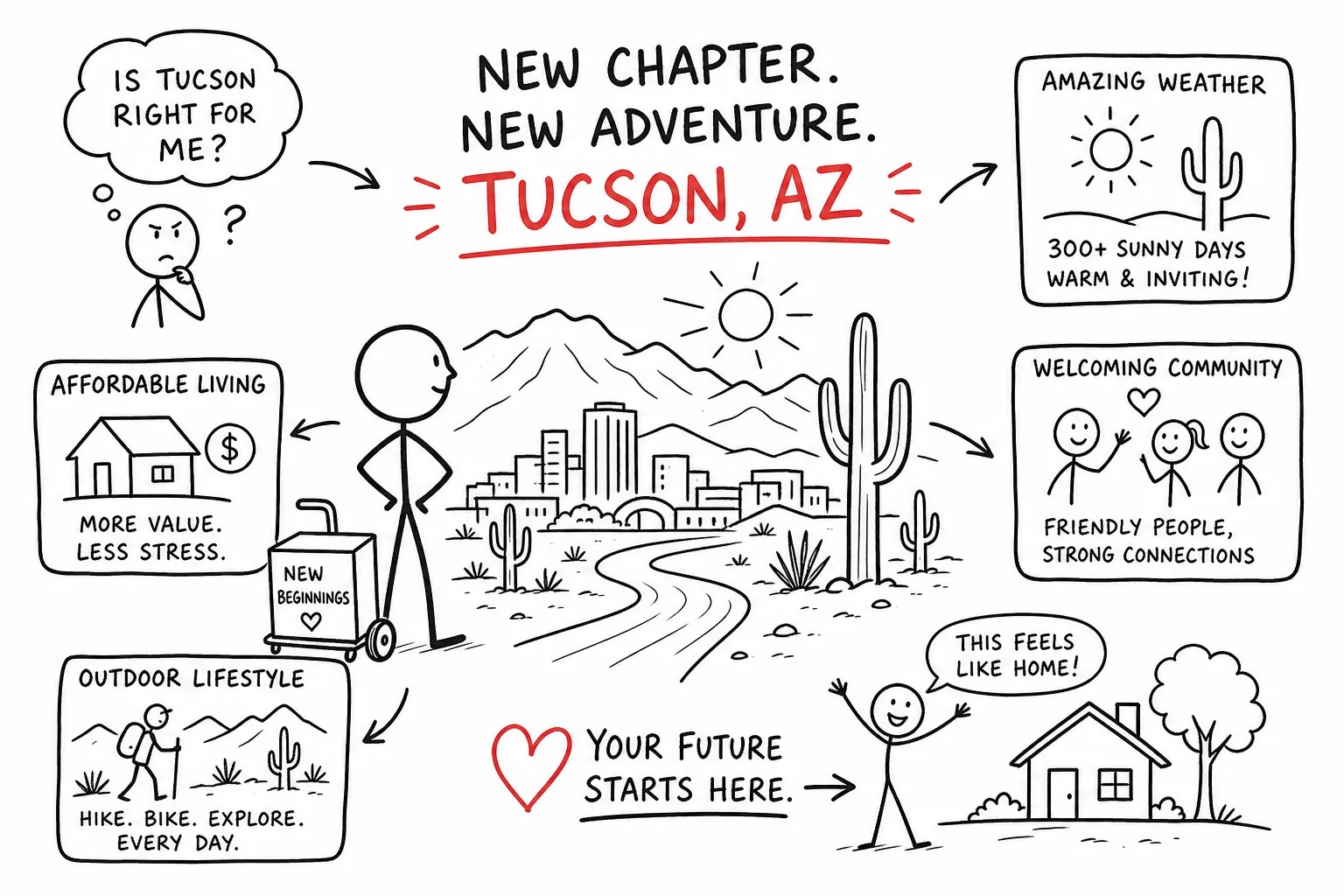
Relocating to Tucson, AZ? The city doesn't get the same hype as Phoenix or Scottsdale, and that's exactly why thousands of people are choosing it every year. It's genuinely affordable, the sun shows up roughly 350 days a year, and the city is made up of distinct communities that suit very different lifestyles. You're not choosing between "urban" and "suburban" here; you're choosing between mountain views in Catalina Foothills, a golf-cart lifestyle in Green Valley, and a walkable college-town vibe near the University of Arizona. That variety is one of Tucson's best-kept secrets.
This guide was shaped by the kind of on-the-ground knowledge I share with out-of-state buyers every single week as a Tucson Realtor with the WIN3 Team at EPIQUE Realty. My clients ask the same questions every newcomer asks: Is it really that hot? Where should I live? What will my budget look like? Can I actually find work there? This guide answers all of those, in the order they matter.
By the time you finish reading, you'll know whether Tucson fits your lifestyle, which two or three neighborhoods deserve a closer look, what your monthly budget should realistically include, and exactly what to do in the first 30 days after you arrive.
Why people keep choosing Tucson over other Southwest cities
The simplest way to frame the Tucson case: you get more for less without sacrificing quality of life. This isn't a second-tier city making do. It's a city with real infrastructure, real culture, and real economic depth that happens to cost significantly less than its neighbors.
The cost gap between relocating to Tucson, AZ and settling elsewhere
Tucson's median rent sits at approximately $1,295 per month, which is around 34% below the national median of roughly $1,950 (Apartment List, mid-2026). Compare that to Phoenix, where median rents run between $2,100 and $2,200 per month, and the math gets even more compelling. For buyers, the Tucson median home price of approximately $293,726 stacks up sharply against Phoenix's near $470,000 (Tucson Association of Realtors, mid-2026). This isn't a trade-off for lower quality, it's a structural market advantage that affects every other financial decision you make after moving here.
Climate, outdoor access, and what "desert living" actually means
Forget the cliche of dry heat. What draws people to living in Tucson is access to Saguaro National Park (both east and west sections), the Santa Catalina Mountains, and over 500 miles of trails across five mountain ranges, a year-round hiking culture that residents take seriously. The summer heat is real and worth planning around, but the winters are mild and the spring and fall are spectacular. Ask any first-year resident and monsoon season is the thing they mention unprompted: the dramatic desert transformation catches nearly everyone off guard in the best possible way.
A city with real economic roots
Tucson isn't a one-sector town. Raytheon Missiles and Defense, the University of Arizona, Davis-Monthan Air Force Base, and a growing healthcare network give the city economic stability that smaller Arizona markets simply don't have. That diversity matters when you're making a long-term housing decision, because stable employment keeps the housing market healthy and city services well funded.
Relocating to Tucson, AZ: Finding your neighborhood fit
Tucson spans a wide geographic footprint with eight distinct communities: Tucson proper, Oro Valley, Marana, Vail, Sahuarita, Saddlebrooke, Green Valley, and Tanque Verde. The right fit depends almost entirely on your lifestyle priorities. Rather than listing every option, here are three profiles that match where most newcomers end up.
Best Tucson neighborhoods for families
Catalina Foothills consistently ranks among the safest areas in the city, with a 97% high school graduation rate and residents reporting a safer environment than 67% of the city average. Oro Valley offers a sparse suburban feel with excellent schools, strong parks infrastructure, and a safety profile that makes it one of the most searched areas for families moving to Tucson. Sam Hughes brings a more historic, walkable character, sits near Himmel Park, and is safer than 86% of the city. Typical rent in family-oriented neighborhoods ranges from $1270 to $1,925 per month depending on size and location. For school quality, the Vail Unified and Catalina Foothills Unified districts are the two most sought-after in the metro area.
Where young professionals tend to land
Poets Square delivers walkability, proximity to the University of Arizona, and one-bedroom rents around $1,025 per month. Broadmoor-Broadway is quieter but still centrally located, safer than 86% of the city, and available around $985 per month. Peter Howell puts you close to downtown, Reid Park, and a solid dining scene without the premium pricing. These neighborhoods offer the urban energy of a much larger city at a fraction of what the same lifestyle costs in Phoenix or Austin.
Top picks for retirees and active adults
Green Valley was purpose-built with retirement in mind: quiet streets, strong social infrastructure, and monthly rents typically ranging from $1,600 to $1,800. Oro Valley doubles as an excellent retirement pick with golf, parks, and shopping all within easy reach. Rita Ranch offers community-event-driven living in a well-maintained suburban setting at around $1,850 per month for a one-bedroom. For 55+ community seekers who want a master-planned environment north of the city, Saddlebrooke deserves a dedicated look.
Tucson cost of living: what your budget actually looks like
Budget planning for a Tucson relocation works best when you account for the numbers that actually surprise people, not just the rent. Housing costs are lower than most markets. A few other line items require more attention than newcomers typically expect.
Rent vs. buying: where the numbers stand right now
The approximately $1,295 median rent is a strong entry point. One-bedroom options in desirable neighborhoods range from $970 in Armory Park to $1,850 in Rita Ranch, giving you genuine options across a broad budget range. For buyers, the roughly $293,726 median home price is dramatically more accessible than Phoenix. With approximately 2,833 active listings in the market as of mid-2026 and a sale to list ratio of 98% (Tucson Association of Realtors), there's real inventory to work with. Homes that are priced and staged correctly are closing in a median of 29 days, so acting with good information matters.
The utility cost that surprises most newcomers
Monthly utilities average between $278 and $290 during moderate seasons, but summer changes that math fast. Electricity alone runs $150 to $220 per month on average and can spike to $300 to $550 during peak summer for larger homes. The reason is straightforward: intensive AC use from June through September is non-negotiable in a desert climate. Treat this as a planning factor, not a dealbreaker. Strategies like balanced billing programs through Tucson Electric Power (TEP), keeping your thermostat at 78 degrees, and having your AC unit serviced before June all make a meaningful difference in what you pay.
Groceries, transportation, and everyday spending
Tucson's overall cost of living runs about 3% above the national average, driven largely by groceries and utilities rather than housing. Grocery costs for a single person run roughly $500 to $570 per month, about 5% above national norms. Gas prices sit around $3.50 per gallon. Most residents rely heavily on cars given Tucson's spread out layout, so factor vehicle costs into your monthly budget as a consistent line item, not an afterthought.
Tucson's job market: who's hiring and in which sectors
For anyone evaluating a move to Tucson based on career opportunity, the employment picture is more robust than the city's reputation suggests. Consider the anchor employers alone: they represent tens of thousands of stable, long-term positions spread across engineering, healthcare, education, and skilled trades.
The anchor employers that stabilize Tucson's economy
Raytheon Missiles and Defense employs more than 12,000 workers and holds the title of Tucson's largest private-sector employer. The University of Arizona follows at 11,251 employees. Davis-Monthan AFB adds 8,580 positions, and Banner University Medical Center rounds out the top tier with 6,272 workers. These aren't startups or experimental operations. They're long-established institutions that have anchored the Tucson economy through market cycles and provide consistent hiring pipelines.
Growing sectors worth watching before you move
Defense and aerospace employ at eight times the national average in Tucson, a number that's genuinely unusual for a mid-sized American city. Healthcare and professional services account for 26% of total employment and are actively recruiting across the metro. Amazon and Caterpillar are expanding logistics and technology operations in the region, adding momentum to an already growing infrastructure base. For retirees evaluating the move, this economic depth matters because a well-employed city maintains property values and supports services far more reliably than one dependent on a single employer or seasonal tourism.
Your practical Tucson relocation checklist
Once you've decided Tucson is the right move, the first 30 days have a specific order of operations. These tasks are time-sensitive, some depend on others being completed first, and sequence matters more than most people realize.
Set up utilities first: this unlocks everything else
Utility bills in your name serve as primary proof of Arizona residency, and you need that proof for both your driver's license and vehicle registration. Set up electric, water, and internet service immediately when you take possession of your new home. TEP (Tucson Electric Power) and Tucson Water handle most residential accounts. Cox and Xfinity are the main internet providers. Getting those bills issued in your name is the first step in your entire administrative checklist, not optional, not something to get to later.
Arizona DMV: the 30-day window and what to bring
New residents have 30 days to register their vehicle and obtain an Arizona driver's license. Vehicle registration requires an emissions test (required in Pima County), your out-of-state title, and a visit to an MVD office or an authorized third-party location. For your license, bring your out-of-state license, an original birth certificate or passport, your Social Security number, and two proofs of Arizona residency. Those utility bills you set up in week one are exactly what you need here. Your physical license arrives by mail within 15 days after your office visit.
Heat-season moving tips that locals don't think to mention
If you're moving between June and September, plan your move for early morning or late evening. Movers and delivery crews work fast in those windows because the alternative isn't pleasant for anyone. Stock your new home with water and cold food before moving day so you're not making store runs during peak heat. Get your AC unit serviced before summer, waiting until July means a three-week wait for HVAC technicians across the metro. Pre-schedule utilities for the same week you take possession so cooling is operational on day one.
How a local Tucson expert changes your relocation outcome
Reading a relocation guide like this one gives you a strong foundation. Translating that foundation into a specific home in the right neighborhood at the right price requires someone who knows the Tucson market inside and out.
Why hyperlocal knowledge matters in a city this spread out
Each of Tucson's eight distinct communities has its own price range, lifestyle, inventory rhythm, and future development trajectory. Oro Valley and Marana look similar on a map but feel different to live in and perform differently as investments. Green Valley and Sahuarita are both south of the city but attract completely different buyer profiles. Working with an agent who knows all eight communities gives out-of-state buyers a significant informational advantage over working with someone who knows only one corner of the market. That advantage shows up in the offer strategy, the neighborhood shortlist, and the final negotiated price.
Tools and support that make remote searching work
As part of the WIN3 Team, I can offer a free home valuation, help you search by neighborhood, price, or listing ID, and walk you through your options on your timeline, whether that means a video call this week or an in-person tour during a scouting trip.
Relocating to Tucson, AZ: your next move
The case for moving to Tucson is straightforward: the costs are structurally lower and unlikely to close dramatically, the neighborhoods are genuinely varied without forcing lifestyle compromises, and the logistics of getting settled are more manageable than most people expect when they first start researching the city.
The hardest part of any relocation is knowing the right questions before you commit. This guide gives you the framework. A local expert with deep Tucson knowledge gives you the specifics that no article can fully provide, including which streets are best for your commute, which HOAs to avoid, and which listings are priced to move versus priced to sit.
As your Navy veteran, Tucson based Realtor, I've helped buyers relocating from out of state land in the right neighborhood with confidence. If you're relocating to Tucson, AZ, reach out for a free consultation or use the home search tools on win3team.com to start building your shortlist. The city is ready when you are.
Categories
Recent Posts




GET MORE INFORMATION