
Tucson, Arizona Cost of Living: The 2026 Real Numbers
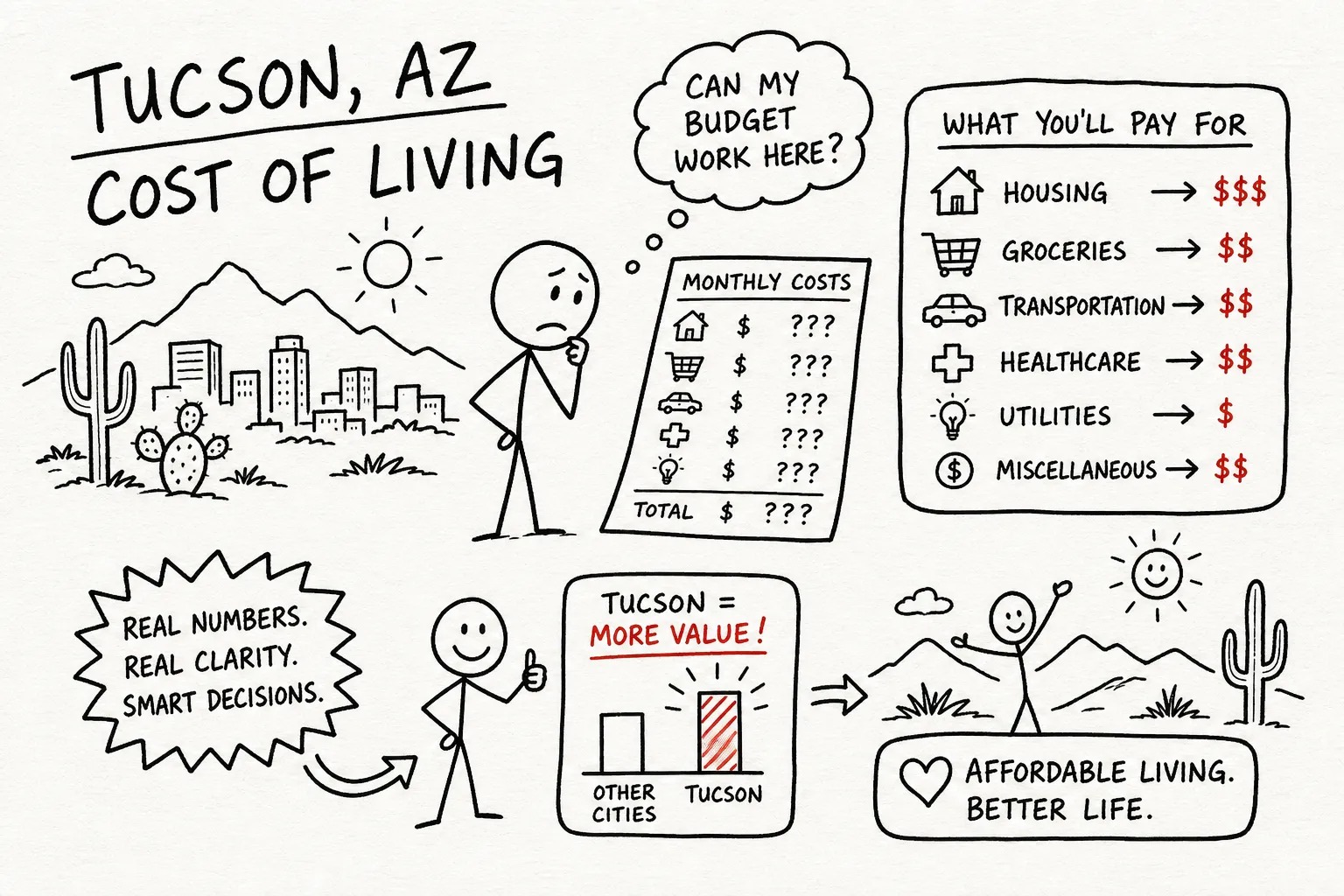
Tucson, Arizona cost of living in 2026 is generating serious interest from people looking for an affordable alternative to Phoenix, California, and other high-cost metros. The word "affordable" gets thrown around a lot, but what it actually means depends on your income, your family size, and the lifestyle you're trying to build.
This guide cuts through the noise and gives you the real 2026 numbers: what housing costs (renting and buying), what your monthly expenses will look like beyond the rent or mortgage, how Tucson stacks up against national averages and Phoenix, and whether your salary will actually stretch here. There's also a ready-made budget breakdown at the end you can use immediately. No tourist brochure framing here, if you're seriously evaluating a move, you deserve straight data, not a sales pitch.
Tucson, Arizona Cost of Living: What Housing Actually Costs in 2026
Housing is the largest single line item in any budget, so this is where the conversation has to start. The good news for anyone moving from a coastal city or the Phoenix metro: Tucson's housing market still offers real value.
Renting in Tucson: Current Prices by Bedroom Size
Based on July 2026 data, the average rent in Tucson runs about $999/month for a one-bedroom, $1,289/month for a two-bedroom, and $1,690/month for a three-bedroom. Different sources show slightly different figures, so treat these as solid estimates rather than guaranteed prices.
The most important context: the national average for a one-bedroom apartment is roughly $1,598/month. Tucson one-bedrooms run about 37% below that national benchmark. For renters relocating from Los Angeles, Seattle, or even Phoenix, that gap represents real monthly savings.
Buying a Home: What the Median Price Means for Your Payment
The median home price in Tucson as of May 2026 is $361,000, with single-family homes sitting slightly higher at $380,000. At current 30-year fixed rates of approximately 6.4 to 6.5% (per Freddie Mac's weekly mortgage survey), the principal and interest payment on a $361,000 home comes to roughly $2,000/month, assuming a standard 20% down payment on the full purchase price. Once you layer in property taxes (Pima County averages about 0.70% of assessed value, or around $189/month on a median-priced home, verify your specific parcel at the Pima County Assessor's site), homeowner's insurance, and any HOA fees, your all-in monthly payment lands in the $2,400 to $2,600 range, that's the figure to plan around, not the base mortgage.
A Note on What the Median Price Actually Buys
The median price tells you where the market sits, but it doesn't tell you what your budget buys in a specific neighborhood. A $361,000 budget gets you something very different in the Tucson foothills versus Sahuarita versus midtown. If you want to see real properties in real communities at your actual price point, a free home valuation on win3team.com is a concrete starting point.
Monthly Living Expenses Beyond the Mortgage or Rent
Housing dominates the budget conversation, but the categories below are where people consistently get surprised when they first move to Tucson.
Utilities and the Summer Electricity Reality
Average monthly utility costs run about $382 for a single adult and $886 for a family of four. Those numbers look manageable until you see how they're distributed across the year. During Tucson's summer months (June through September), cooling a typical three-bedroom home can push your electricity bill to $300 to $340/month or higher, with some households reporting bills above $400, particularly in older homes with less efficient HVAC systems. Winter and spring months are far more reasonable at $180 to $300. If you're moving from a mild climate, build the summer spike into your annual budget from day one rather than absorbing it as a surprise.
Tucson Living Expenses: Groceries and Transportation
Grocery costs in Tucson run about 3 to 4% above the national average (based on BLS Consumer Price Index regional data): roughly $717/month for a single adult and $1,459/month for a family of four. Transportation is the budget-friendly counterpoint, coming in about 5 to 6% below the national average at approximately $348/month for a single adult. That figure covers gas (around $3.50/gallon in 2026), auto insurance, and minimal public transit use. A monthly Sun Tran bus pass runs $40 for those who use it. The practical takeaway: groceries cost a bit more here, but getting around costs noticeably less, a meaningful advantage in a spread-out Sun Belt city.
Healthcare: The Cost That Surprises Most Newcomers
Tucson healthcare costs run 8 to 13% above the national average, which catches a lot of people off guard given the city's reputation for affordability. According to the MIT Living Wage Calculator and BLS Consumer Expenditure Survey benchmarks, average monthly healthcare spending is approximately $163 for a single adult and $460 for a family of four, but those figures likely understate actual insurance premiums. Individual marketplace premiums in Arizona rose significantly in 2026 following the expiration of enhanced ACA subsidies; full-price plans can exceed $500 to $700/month for adults depending on age and plan tier. Verify your actual insurance costs before locking in a relocation budget.
How Tucson's Costs Compare to the U.S. Average and Phoenix
Context matters when you're evaluating any city. Here's how Tucson sits against two relevant benchmarks.
Tucson vs. the National Average
The full-picture Tucson affordability index for 2026 looks like this: housing runs 4 to 5% below the national average, transportation runs 6% below, but groceries are 3 to 4% higher and healthcare is 8 to 13% higher. The overall cost of living lands roughly 1 to 3% above the national average when everything is combined. That makes Tucson a near-neutral comparison to the U.S. average on total spend, with a meaningful housing discount built in that offsets the above-average food and healthcare costs for most households.
Tucson vs. Phoenix: The Comparison That Drives Real Decisions
For anyone considering Arizona, the Phoenix comparison is the one that matters most. Phoenix median home prices in 2026 sit in the $450,000 to $500,000 range, with one-bedroom rents commonly running $1,600 to $2,000/month. Tucson housing runs 15 to 25% cheaper than Phoenix across the board. Overall living expenses in Phoenix run 5 to 10% higher than Tucson, based on cost-of-living index comparisons for the two metros. For remote workers, retirees, or buyers who've been priced out of Scottsdale or the east Phoenix suburbs, the Tucson savings are substantial and compounding: lower mortgage, lower rent, lower property taxes, and more purchasing power per dollar.
Can Your Income Actually Cover Life in Tucson?
Abstract cost comparisons only go so far. What matters is whether your specific income covers your specific household expenses.
The Living Wage Baseline and Common Tucson Salaries
According to the MIT Living Wage Calculator, the living wage for a single adult in the Tucson metro in 2026 is $21.37/hour, or approximately $44,489 annually. Tucson's minimum wage is $15.45/hour, which falls well short of that threshold. For a single adult supporting one child, the living wage rises to $37.39/hour ($77,771/year).
Common Tucson occupations benchmark against these figures as follows:
- Teachers (Education, Training & Library): $56,150/year, about 26% above the single-adult living wage
- Registered nurses: $101,490/year, well above what any household configuration requires
- Software developers: $106,140/year, comfortably above the family-of-four living wage
- Average across all Tucson occupations: approximately $52,000 to $55,000/year
A teacher earns enough to live comfortably as a single adult but faces real budget pressure as the sole earner for a family of four, a scenario worth modeling carefully before committing to a mortgage.
The $50,000 Salary Reality Check
Here's a practical scenario. A $50,000/year earner brings home roughly $3,300 to $3,400/month after federal income tax withholding, FICA contributions, and Arizona's flat 2.5% state income tax, use a paycheck calculator set to Arizona to verify assumptions for your specific filing status. A two-bedroom apartment at $1,289/month, combined with approximately $1,610/month in non-housing expenses for a single adult (using the category totals above: utilities, groceries, transportation, and healthcare), totals roughly $2,900/month. That leaves $400 to $500/month for savings, debt repayment, or discretionary spending. It's workable, but not comfortable. Buying at the median price on a $50,000 income is a stretch without a significant down payment to reduce the monthly obligation or a second income in the household.
Neighborhood Cost Ranges Across Tucson's Key Communities
Generic Tucson living expenses data tells you about the city as a whole. Where you actually land within Tucson shifts your numbers meaningfully.
Where to Find Tucson's Most Affordable Homes and Rentals
Buyers working with tighter budgets should look at South Tucson, Drexel Heights, Flowing Wells, and Midvale Park. These areas offer single-family homes ranging from $145,000 to $248,000, with some USDA-eligible zones in Drexel Heights qualifying for zero-down financing. Renters in these corridors can often find two-bedroom apartments under $1,100/month. The trade-off is typically older housing stock and longer commutes to some employment centers, but for first-time buyers or price-sensitive renters, the value is real.
Mid-Range Suburbs with Strong Value: Marana, Sahuarita, and Vail
These Tucson-area suburbs attract young families and relocating professionals who want newer construction, good schools, and community amenities without paying Phoenix suburb prices. Entry-level homes in these communities start around $270,000 to $320,000, with mid-range options extending to $400,000 depending on size and finishes. They still undercut comparable Phoenix suburbs by a significant margin, and the suburban infrastructure, retail, parks, medical access, is fully developed in all three areas.
Tucson, Arizona Cost of Living in Premium Communities
Oro Valley, the Tucson foothills, Saddlebrooke, and Green Valley represent the upper tier of the local market, with home prices commonly running $400,000 to $600,000 and above. These communities draw retirees, physicians, and remote workers prioritizing lifestyle quality, mountain views, and low-maintenance living. A free home valuation is available on win3team.com if you want property-specific data before committing to a search.
Your 2026 Monthly Budget for Tucson: A Practical Template
Here's how the numbers assemble into a real monthly budget for two common household types.
Single Adult Renting a One-Bedroom
Rent at $999, utilities at $382, groceries at $717, transportation at $348, healthcare at $163, plus personal expenses and a modest savings contribution lands you in the $3,000 to $3,500/month range. That corresponds to a gross income of roughly $42,000 to $50,000/year. A single adult earning in that band can live comfortably in Tucson without significant financial stress, provided healthcare costs don't run higher than the model assumes.
Family of Four Owning a Home
An all-in mortgage payment of $2,400 to $2,600, utilities at $886, groceries at $1,459, transportation at $786, and healthcare at $460 puts the monthly total at $6,000 to $7,200. A household income of $85,000 to $100,000+ represents the comfortable threshold for a family of four owning a median-priced Tucson home, with room for savings and discretionary spending. Below that range, the budget works on paper but leaves limited margin for unexpected expenses.
The Bottom Line on Tucson, Arizona Cost of Living
The Tucson, Arizona cost of living in 2026 is genuinely competitive, particularly for buyers and renters arriving from Phoenix, California, or the Pacific Northwest. Housing is where the value story lives: homes priced 4 to 5% below the national average and 15 to 25% below Phoenix give your dollar real purchasing power. Healthcare, groceries, and summer electricity are the categories where costs exceed national averages, and those deserve honest line items in any budget you build.
If the numbers look right for your situation, the logical next step is finding out what your specific budget buys in a specific Tucson neighborhood, that's a different conversation than city-wide averages. As a Tucson based Realtor with the WIN3 Team, I've worked with buyers across Tucson, Oro Valley, Marana, Vail, Sahuarita, Saddlebrooke, and Green Valley. Use the free home valuation tool on win3team.com to see real properties at your price point, or reach out to talk through which community fits your budget and lifestyle goals.
Categories
Recent Posts






GET MORE INFORMATION