
Tucson Housing Market 2026: Prices, Inventory, and Outlook
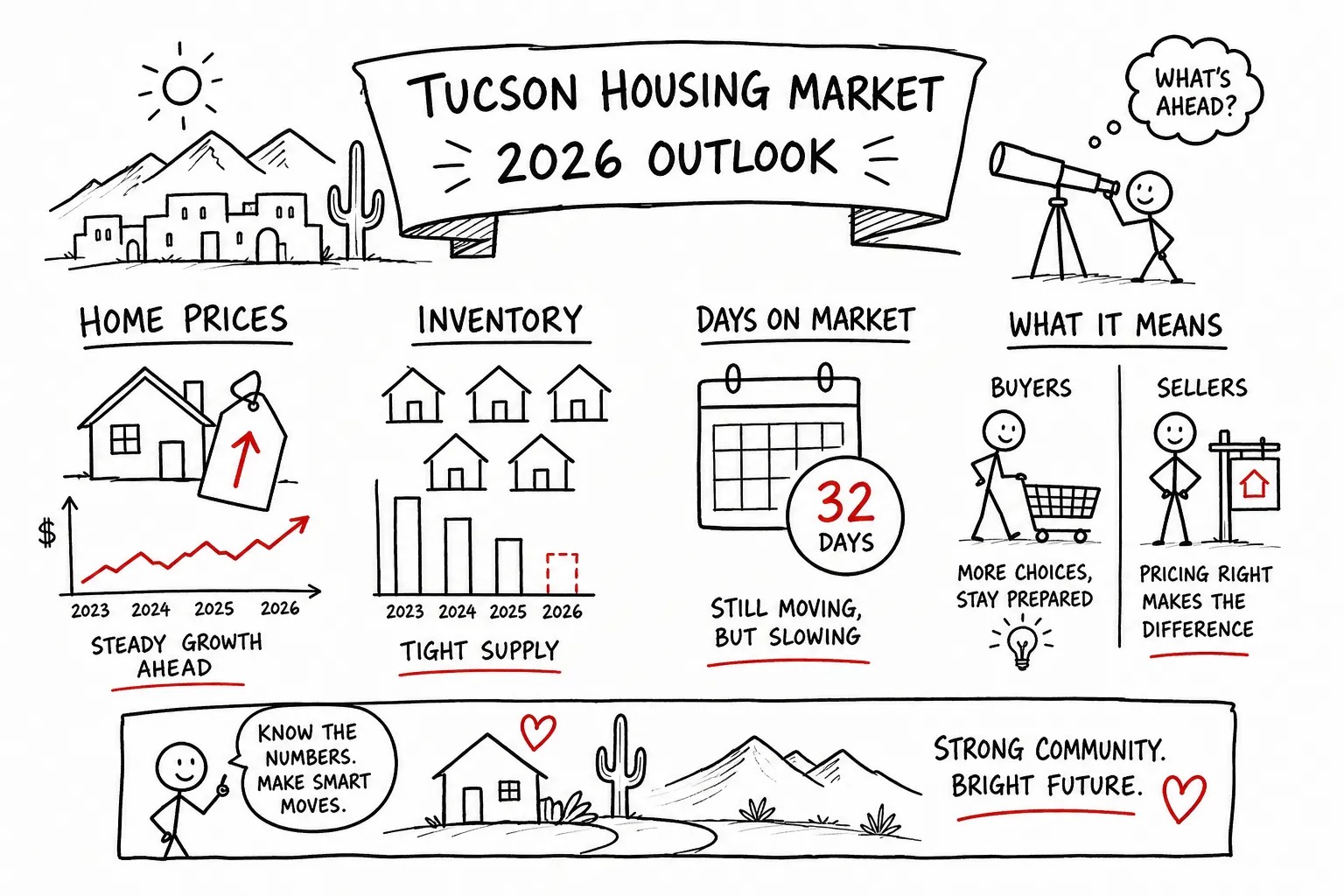
So what is the Tucson housing market doing in 2026? The short answer: it's not the runaway seller's market it was a few years ago, but it's not a buyer's free for all either. The numbers tell a more nuanced story, and reading them correctly is the difference between a confident decision and an expensive mistake. As of June 2026, the median home price in Tucson sits at $357,000, inventory is climbing in segments like luxury and central Tucson, and nearly half of active listings have already cut their asking price at least once.
For buyers, that signals more options and genuine room to negotiate. For sellers, it signals that the list high and wait strategy is over. I've been tracking market conditions across the Tucson metro for years with the WIN3 Team at EPIQUE Realty, and the patterns showing up right now are worth understanding before you make any move. Here's a clear breakdown of the key metrics, neighborhood level differences, and what all of it means for the second half of the year.
Where Tucson home prices actually stand right now
The June 2026 median sale price in Tucson is $357,000, up 1.9% year over year. The average sale price is $440,404, up 1.5% over the same period. That gap between median and average isn't a reporting error. It reflects luxury homes pulling the mean upward. For most buyers and sellers, the median is the more useful number because it represents the midpoint of all actual sales, unaffected by a handful of $1M+ transactions in the Catalina Foothills.
If you've seen figures like $360,000 or $363,950 cited elsewhere for the same period, the discrepancy comes down to dataset scope. Some reports filter by property type, some include the full metro, and others capture a specific subset of closed sales. The practical takeaway is consistent across all of them: Tucson home prices are holding steady with modest appreciation. This isn't a crashing market, and it isn't a surging one. It's a market that rewards accurate pricing and punishes wishful thinking.
Inventory is rising, but the market isn't flooded
Months of supply and what it means
In June 2026, Tucson had 2,833 active listings and 1,027 new listings, with new supply actually down 11.5% compared to June 2025. Months of supply sits at 3.28. That figure matters because a balanced market is generally defined as 4 to 6 months of supply, meaning Tucson still leans slightly toward sellers. Earlier in the spring, some reports showed active listings reaching 4,800 to 5,600 depending on the dataset, so the current count reflects a partial correction as demand absorbed excess inventory through the spring selling season.
Active listings versus new listings
Pending sales in June 2026 came in at 830, up 3.8% year over year. That number directly counters any narrative that buyer demand has evaporated. Buyers are active, they're just more selective. Compared to Phoenix area markets that have moved toward 4.5 to 5.5 months of supply, Tucson's 3.28 months keeps it tighter than most other Arizona metros. Sellers still hold a modest structural advantage, but the cushion is thinner than it was in 2023 or 2024.
At the county level, Pima County housing trends mirror the metro picture. Median sale prices have held in positive territory year over year, total sales volume has edged up roughly 4%, and active inventory, while higher than 2023 peaks, remains below the threshold that would shift pricing power decisively toward buyers. That county wide stability is part of why Tucson's market continues to attract relocating buyers even as coastal markets soften more sharply.
Days on market and price reductions
The median days on market in Tucson reached 31 days as of May 2026, down from 36 days in February, which tells you the spring selling season generated real momentum. Homes are moving, but the pace is nowhere near the 2021, 2022 frenzy. Well priced homes in desirable suburban areas are still going quickly. The issue is the segment of listings that aren't well priced, and that segment is sizeable right now.
As of May 2026, 49% of active listings had at least one price reduction, with the average reduction landing around 6.5%. This doesn't mean the market is falling apart, a large number of sellers simply started with unrealistic list prices and had to adjust. For buyers, that creates genuine negotiating leverage when you know which listings are motivated and how long they've been sitting. For sellers, it's a straightforward warning: the cost of overpricing isn't just a slower sale, it's a public price cut that signals desperation to every buyer who walks through the door.
It's worth separating two different but related figures here. One dataset measured 21.6% of Tucson listings with a price cut in May 2026, compared to 17.5% nationally, a meaningful gap even at that level. A separate local market calculation tracking all active listings with at least one reduction pushed that share toward 49% to 50% by late spring. Both metrics point in the same direction: Tucson's price reduction rate runs well above the national average, and accurate pricing functions as a competitive weapon, not just a preference.
The neighborhood divide: who's ahead and who's waiting
The most important thing to understand about the Tucson housing market in 2026 is that it isn't one market. It's several markets stacked on top of each other, and the differences between them are significant. Oro Valley leads the entire region in sales volume growth, up 15% year over year, with a median value around $475,000. Marana (up 8%) and SaddleBrooke (up 12%) are also outperforming the broader market. Vail posted 10% sales volume growth, driven largely by newer construction and strong school district ratings. These communities benefit from a lifestyle profile that attracts families and relocating buyers. The fastest selling ZIP code in the metro right now is 85737, where homes are clearing in roughly 5 days.
The East Side near Davis Monthan Air Force Base holds steady at around $425,000, insulated by consistent military driven demand that buffers the submarket from broader softening. Downtown Tucson and the West University area remain competitive for a different reason: walkability and limited supply create their own pricing floor in those neighborhoods, keeping inventory low and qualified buyers engaged.
Luxury Tucson tells a different story entirely. The Catalina Foothills has seen luxury inventory jump 89%, with a median price of $785,000 and the 85718 ZIP code hitting $857,000. Homes in that segment are averaging 58 days on market, nearly twice the metro wide figure. Central Tucson has seen inventory climb 62%, creating a more balanced environment for buyers in that price range. On the opposite end, the most affordable entry points in the metro sit in ZIP codes 85713 ($254,000) and 85705 ($255,000), which continue to attract first time buyers priced out of the suburban markets.
What this market means if you're buying or selling right now
If you're buying, you have more leverage than at any point in the past several years. With nearly half of listings carrying price reductions and a metro median of 31 days on market as of May 2026, there's real room to negotiate on price, repairs, and closing costs. That said, the competitive pockets in Oro Valley, Vail, and Marana don't follow that pattern. In those markets, strong offers still need to move quickly. Your strategy should be shaped by the specific neighborhood you're targeting, not by broad headlines about the overall market.
If you're selling, the picture is different. Homes listed above market price are accumulating days on market and eventually making public cuts that weaken their negotiating position. With 3.28 months of supply, you still have structural support, but that support disappears the moment your list price is disconnected from the comparables. Marketing reach, presentation, and pricing discipline matter more now than they did when low inventory made everything sell automatically.
The WIN3 Team at EPIQUE Realty works with sellers across the Tucson metro using a multi point marketing strategy that includes TV, radio, and direct mail outreach, channels designed to generate broader buyer exposure beyond what MLS syndication alone reaches. In a market where overpriced listings are sitting 30 plus days and absorbing an average 6.5% price reduction, getting in front of the right buyers early makes a measurable difference in your final net proceeds. You can start with a free evaluation at win3team.com/evaluation.
What to expect from Tucson real estate through the rest of 2026
The data through the first half of 2026 supports a cautiously optimistic outlook for the second half. Closed sales rose between 4% and 4.8% year over year in June, and pending sales recovered to positive territory by mid year after a slow start in January and February. Those are signals that the market found its footing after early year uncertainty, and that momentum is likely to carry into fall. Most housing analysts tracking Arizona markets are forecasting modest price appreciation in the 2% to 4% range for 2026 overall, a projection consistent with the trajectory already visible in the monthly data.
Suburban communities will continue to lead in sales volume. Luxury inventory in the Foothills will remain elevated, keeping that segment buyer friendly through the rest of the year. Mortgage rates stabilizing in the low to mid 6% range have removed some of the friction that suppressed activity earlier in the year, and Tucson's job base in healthcare, technology, aerospace, and defense continues to support steady local demand. The broader economic picture points to normalization, not reversal.
What won't work in the second half of 2026 is approaching this market with 2022 assumptions. Generic national headlines are particularly unreliable right now because the divergence between submarkets is sharper than usual. A home in Marana and a home in the Catalina Foothills are operating in fundamentally different conditions, even though they share the same metro area designation.
Get the full picture before your next move
To recap what the Tucson housing market is doing in 2026: the median home price is $357,000 with modest 1.9% annual appreciation, months of supply sits at 3.28, metro median days on market hit 31 in May, and 49% of active listings have already cut their price. Suburban markets are outperforming, luxury inventory is elevated, and the market rewards preparation over optimism on both sides of the transaction.
The second half of 2026 will likely bring continued gradual price gains, stable to slightly rising inventory, and a market that sits closer to balanced than to either extreme. That's a healthy environment for buyers who are ready to act and for sellers who price their homes correctly from day one. The conditions are workable. The question is whether your strategy matches them.
I provide free, personalized Tucson housing market snapshots rooted in current local data, not figures from six months ago. Whether you're timing a sale, evaluating a specific neighborhood, or relocating to Tucson from out of state, reach out to me and the WIN3 Team for a clear picture of what the numbers mean for your specific situation.
Categories
Recent Posts





GET MORE INFORMATION