
Tucson Neighborhoods: Best Places to Live in 2026
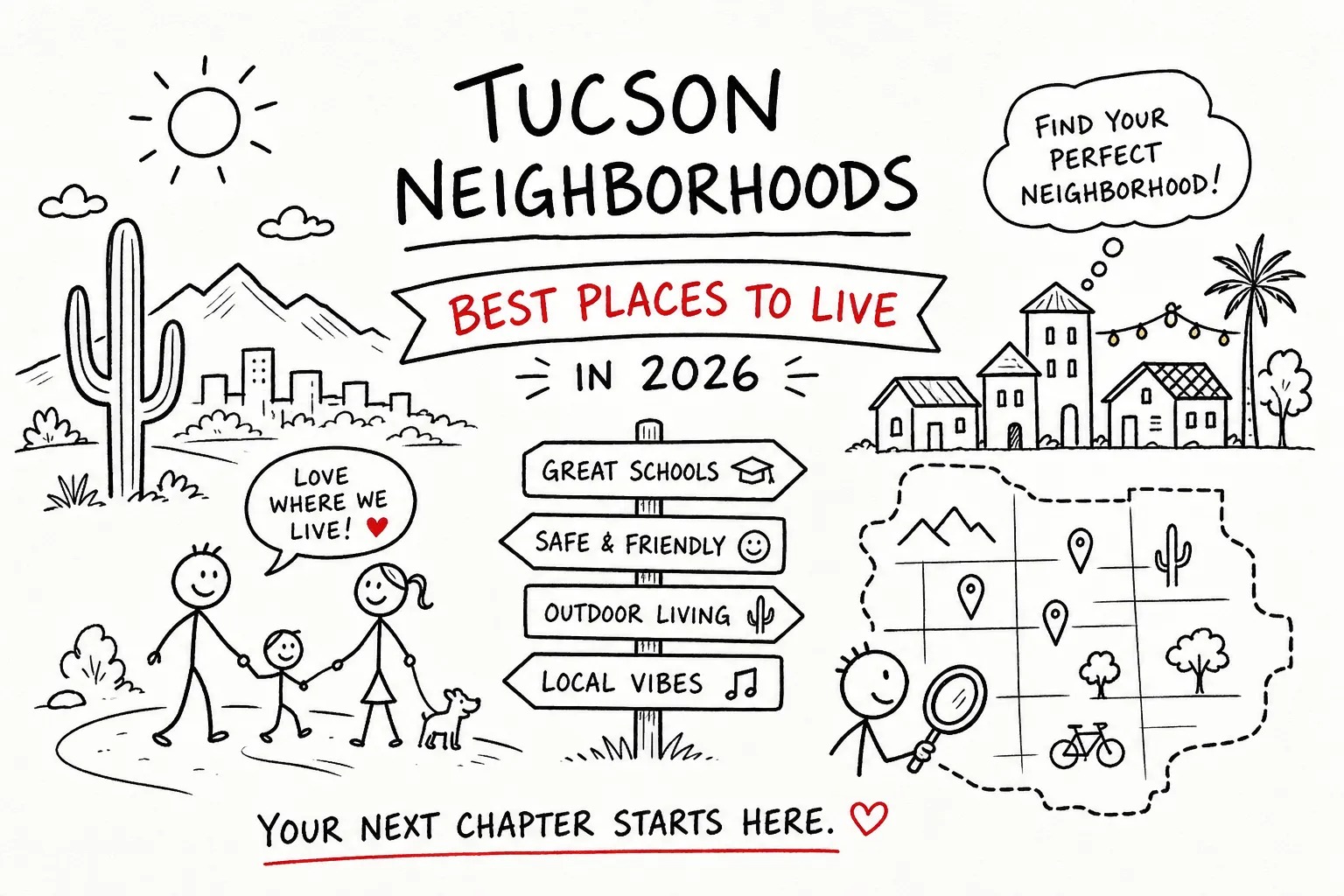
Tucson neighborhoods look like one city on a map, but they actually function as a dozen distinct communities stitched together by desert roads and mountain views. The neighborhood you choose determines your school district, your commute, your home's appreciation potential, and frankly, your daily quality of life. Whether you're relocating from out of state, buying your first home, or searching for the safest block to plant roots, the right neighborhood changes everything.
This guide breaks down the best neighborhoods in Tucson that come up most often in buyer conversations, using 2026 crime data, school district ratings, home price benchmarks, and commute realities. Use it as your starting point, then take the next step with someone who knows these streets.
How Tucson's Layout Works Before You Pick a Neighborhood
Most buyers make the mistake of searching by price first and geography second. In Tucson, that approach backfires quickly. A home that fits your budget in one zone might sit inside a school district you'd never choose, or add 40 minutes to your morning commute. Understanding the four general geographic zones first narrows your search dramatically.
The City of Tucson maintains an official interactive neighborhood association map at associations-and-neighborhood-maps.tucsonaz.gov, last updated March 2026, which shows verified boundary lines and neighborhood contact information for every registered association. The Pima Association of Governments GIS portal offers downloadable boundary layers for anyone who wants to dig deeper into parcel-level geography. Five minutes with either tool before you start touring saves hours of confusion later.
The Four Zones and What Each One Offers
The northwest zone (Marana, Oro Valley, Dove Mountain) delivers newer master-planned communities, top-rated schools, and some of the lowest crime rates in the metro, the clearest fit for buyers who put safety and school ratings at the top of their list. The central and midtown zone offers mid-century homes, University of Arizona access, and established neighborhoods with genuine character that newer subdivisions simply can't replicate. The east side (Tanque Verde, Vail, Civano) gives families strong schools, newer construction, and relative affordability, a combination that makes it one of the most sought-after areas among buyers with children. The urban core (downtown, near-university) trades lot size for walkability, historic charm, and commutes measured in minutes rather than miles, drawing faculty, young professionals, and anyone who wants city life at a Sun Belt price point.
How to Use the Official Tucson Neighborhood Map
The City of Tucson's interactive map at associations-and-neighborhood-maps.tucsonaz.gov shows association boundaries overlaid on the road network with contact details for each registered group. You can identify which neighborhood association covers a specific address, find ward lines, and pull up officer contact information before you ever set foot on a street. Checking this before a showing gives you a concrete sense of community infrastructure and how organized a neighborhood is, details that matter more than most buyers realize.
Tucson Neighborhoods: Safest Areas in 2026
Tucson's overall violent crime rate dropped 41% from 2005 to 2024, reaching a 20-year low. That's a meaningful trend, and it shows up clearly in the neighborhood-level numbers. The safest communities in the metro cluster in two places: the northwest suburban corridor and the southeast side, where the chance of being a crime victim drops as low as 1 in 56 compared to 1 in 18 in some central pockets.
Northwest and Suburban Communities with the Lowest Crime Rates
Dove Mountain posts roughly 18 crimes per 1,000 residents (safety index: 95/100), making it the safest community in the metro by most measures. Oro Valley comes in at approximately 19 per 1,000, and Rancho Vistoso sits at around 20 per 1,000 (safety index: 94/100). All three are master-planned areas with active HOAs, newer construction, and strong community infrastructure. Civano on the southeast side checks in at approximately 22 per 1,000 and is safer than 83% of neighborhoods in Tucson AZ, giving east-side buyers a comparable safety profile without the northwest price premium.
What Crime Numbers Mean in Practice for Everyday Life
Lower crime rates in suburban zones come with trade-offs: longer commutes and higher price points are the two most common. For buyers who want reasonable safety without leaving the urban core, Sam Hughes carries a 91/100 safety index and Armory Park scores 88/100. Both sit within 15 minutes of the University of Arizona and downtown employment, making them strong options for professionals who value proximity. The numbers frame the conversation; local, street-level knowledge fills in the nuance, which blocks are quietly shifting, where infrastructure investment is following, and what the statistics alone can't show you.
Best Tucson Neighborhoods for Families: Schools, Home Prices, and Stability
School district quality is the strongest predictor of long-term satisfaction for family buyers in Tucson, and the variation across the metro is sharp. The top-ranked districts sit far apart geographically, which means school priorities almost always point a family toward one zone before they've toured a single property. Getting clear on this early saves weeks of searching in the wrong direction.
Top School Districts and the Communities They Cover
Vail Unified (A+, #1 district in Tucson) covers east-side communities including Civano, Rita Ranch, and Vail proper, with school ratings of 9 to 10 out of 10. Top individual schools include Empire High School and Senita Valley Elementary. Catalina Foothills USD (A) covers the northwest foothills and earns recognition for college readiness and smaller class sizes, averaging 17 students per class versus the state average of 22. Tanque Verde USD (A) serves east Tucson with a smaller, tight-knit district that performs on par with Vail. For context, Tucson USD earns a B and serves the largest geographic footprint in the metro, while Sunnyside USD rates a B with a 2 out of 10 school quality score.
What Families Are Paying to Live in the Top School Zones
Civano homes sell at a median of approximately $339,000, making it one of the more accessible entry points among top-performing school zones. The broader Vail area sits at a comparable price point, and Tanque Verde is similarly positioned. Catalina Foothills commands a premium that reflects its luxury positioning and mountain views. The citywide median sits at roughly $350,000 in mid-2026, so families choosing Vail or Civano can access top-ranked schools without paying significantly above market. That combination of value and school quality is genuinely hard to find in most Sun Belt metros.
Historic Tucson Neighborhoods Near the University of Arizona
The neighborhoods closest to the U of A and downtown offer something the suburbs can't replicate: walkability, architectural character, and commutes measured in minutes. These are Tucson's most recognizable historic districts, built with Craftsman bungalows, mature tree canopies, and street grids designed for people rather than cars. Faculty, young professionals, and urban-lifestyle buyers return to these blocks consistently, and for good reason.
Campus-Adjacent Communities Worth Knowing by Name
Sam Hughes, just east of campus, carries a median sale price around $511,000 and a competitive market where homes typically sell close to list price. It draws buyers who want architectural character and proximity to the university in the same package. West University sits directly west of the U of A with streetcar access and genuine walkability to downtown, while Jefferson Park offers a quieter residential feel north of campus for buyers who want the location without the street-level activity. Blenman-Elm provides central access near Broadway and Campbell with easy midtown reach, and Pie Allen rounds out the group as a southwest-of-campus option known for relative value and short commutes. All five sit within a 15 to 20 minute drive of the university, downtown, and midtown employment, with several walkable or bikeable for daily errands.
What to Expect from Home Prices and Rental Availability in These Areas
Downtown Tucson homes have a median price around $480,000 and Armory Park sits near $441,000, both reflecting strong demand against limited inventory. These are negotiation-friendly markets where homes often sell slightly below list price, an edge a knowledgeable agent can put to work for a prepared buyer. The citywide median rent of $1,675 per month provides a baseline, though specific units in these high-demand corridors tend to run above that figure. In neighborhoods where inventory turns over quickly, buyers who arrive with financing in place and a clear sense of priorities tend to secure better outcomes than those still deciding what they want.
Affordable Tucson Neighborhoods and Suburban Picks for Every Budget
Tucson's affordability advantage over Phoenix, Austin, or Denver is real, and it shows up clearly at the neighborhood level. A budget that buys a small condo in most Sun Belt metros gets a three-bedroom home with a yard in Tucson. The key is knowing which communities deliver the best combination of price, livability, and upside.
Entry-Level Neighborhoods That Still Deliver Quality of Life
Dunbar-Spring, a revitalizing historic area with a strong neighborhood association, sits at a median of approximately $347,000 and offers genuine community character without the premium of Sam Hughes or Armory Park. Civano on the southeast side checks in near $339,000 and delivers a master-planned eco-community with low crime rates and Vail school access in one package. Both represent the kind of value that first-time and budget-conscious buyers consistently overlook when they anchor too quickly to the most visible neighborhoods.
Suburban Corridors with Newer Homes and Room to Grow
Marana in the northwest is growing fast, with a developing retail and employment base that reduces dependence on a long commute downtown. Sahuarita to the south offers master-planned communities like Quail Creek with newer construction, larger lots, and HOA amenities at price points below the city median. Vail to the east combines top-ranked schools with newer builds and quieter streets, a profile that continues to attract families priced out of Catalina Foothills but unwilling to compromise on school quality.
How to Narrow Down Your Neighborhood and Take the Next Step
The fastest way to identify your best-fit community among the many neighborhoods in Tucson AZ is a simple priority-ranking exercise. List your top three non-negotiables from this set: commute direction and time, school district rating, safety profile, home price ceiling, walkability, or lifestyle access. Then cross-reference those priorities against the geographic zones covered in this guide. Most buyers find that two or three of those filters eliminate half the map immediately.
A Simple Checklist for Matching Priorities to Communities
Four questions cut through most of the noise. Where do you or your partner work, and how much daily drive time are you willing to accept? Do you have school-age children, and which district rating is the floor for your family? Do you want to walk to dinner on a Tuesday night, or are you happy driving? What is the maximum you're comfortable spending, and are you open to a 20-to-30 minute commute to access a lower price point? Answering these honestly points most buyers toward a single geographic zone before they've scheduled a single showing.
Why Working with a Hyperlocal Tucson Expert Changes the Outcome
Data gives you a framework, but it doesn't tell you which streets flood after monsoon season, which blocks are quietly gaining momentum before prices move, or what Tuesday morning traffic actually looks like on Houghton Road versus Tanque Verde. As a Tucson based Realtor with the WIN3 Team, I work these zones regularly, from Dove Mountain's quiet cul-de-sacs to West University's bungalow blocks, and I can offer a free home valuation and neighborhood-specific property search for buyers who want to go deeper than a blog post. When you're ready to move from research to a real decision, that's exactly the conversation I'm here for.
Your Next Move Starts with Knowing Your Priorities
Tucson neighborhoods are genuinely different from one another, and the right choice depends entirely on your situation. Safety, schools, commute, budget, and lifestyle all pull in different directions depending on the life you're building. Use the official City of Tucson neighborhood map as a starting point to visualize boundaries, then layer in the data from this guide to build a short list of communities worth touring.
What the numbers can't capture is what makes a neighborhood feel right: the morning energy on a residential street, the quality of neighbors who show up to association meetings, which areas are quietly in demand before the market reflects it. Reach out on win3team.com for a neighborhood-by-neighborhood conversation built around your specific situation, the kind of guidance that goes well beyond any checklist.
Categories
Recent Posts



GET MORE INFORMATION