
How to Get Top Dollar Selling Your Home: A Proven Guide
If you want to know how to get top dollar selling your home, the answer rarely comes down to market conditions alone. Many sellers lose material proceeds because of avoidable pricing, preparation, or negotiation mistakes, not solely because of broader market trends. Overpricing by 5%, skipping a low cost curb appeal refresh, or accepting the first offer without comparing net proceeds can each contribute to leaving $10,000 to $50,000 on the table. That's not a market problem. That's a preparation and strategy problem.
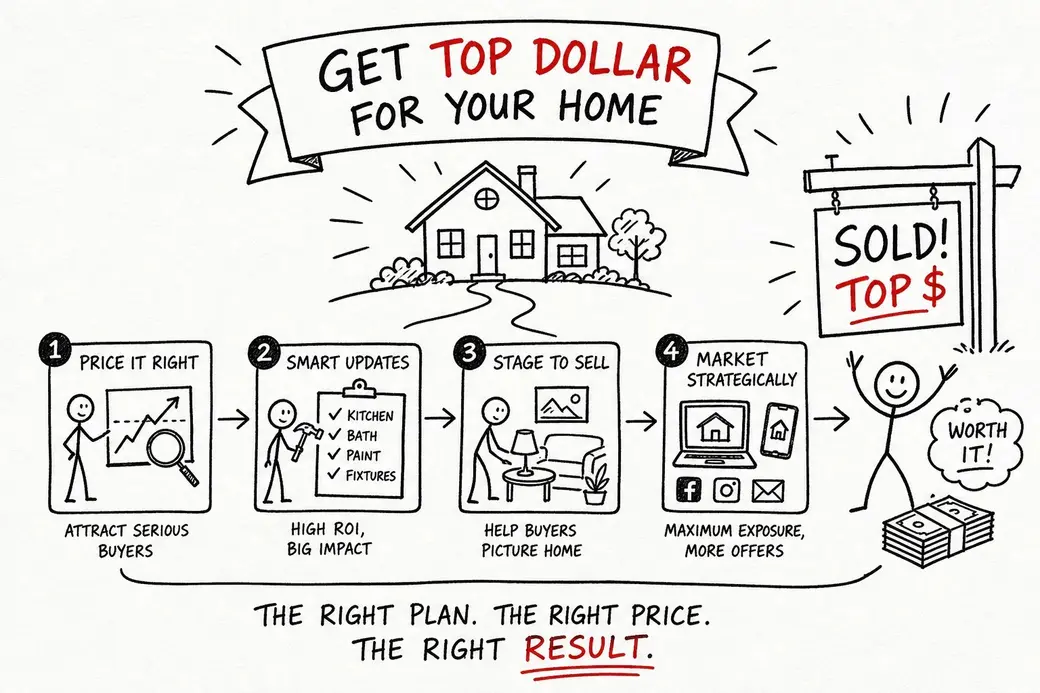
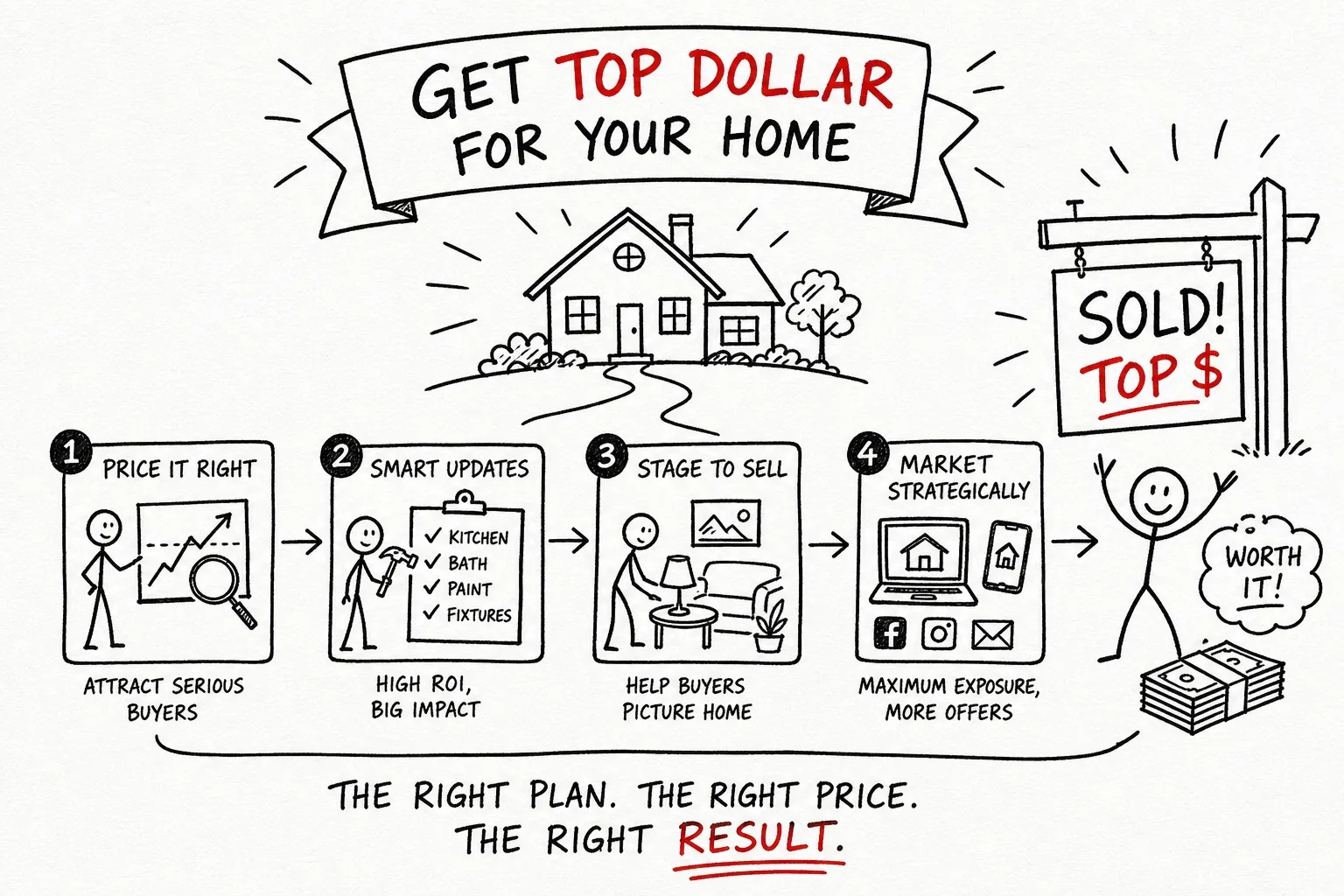
There are four levers that control what you walk away with at closing: pricing, preparation, presentation, and timing. Pull all four correctly and you create conditions where buyers compete for your home. Miss even one and you're negotiating from a weaker position than you need to be.
I work with sellers across Tucson using this exact framework, and the results consistently outperform what a generic, one size fits all approach delivers. This guide gives you a prioritized action plan, ranked by financial impact, so you know exactly what to do and in what order before you list.
Set the Right Price to Get Top Dollar Selling Your Home
Pricing is the single highest leverage decision you'll make as a seller. Get it right and everything else you do compounds. Get it wrong and no amount of staging or marketing will fully recover your position.
Why your list price is also your marketing tool
Buyers search for homes using price filters with hard upper limits. Listing at $499,000 versus $501,000 puts your home in front of a completely different pool of buyers, including everyone who capped their search at $500,000. A well priced home that attracts multiple qualified buyers in the first week creates the kind of early competition that frequently drives final sale prices above list. An overpriced home quietly sits, and sitting homes lose leverage fast.
The cost of going stale on the market
When a listing is priced too high and later requires a reduction to generate activity, that price cut typically runs around 10%, erasing any premium the seller was holding out for. In markets like Austin, homes that sat 10 or more days longer than average saw price drops of 8.3% per square foot. In plain terms, every week of overpricing costs sellers far more than the premium they were hoping to protect. The imagined buffer evaporates quickly once buyers start wondering why a home hasn't moved.
How a comparative market analysis gives you a defensible number
A CMA uses recent closed sales, not active listings, to establish where the market has actually transacted. Active listings tell you what sellers are hoping for; closed sales tell you what buyers have paid. A skilled agent uses this data to pinpoint a price that attracts serious buyers without leaving equity behind. That's the number worth anchoring to.
Pre-Listing Repairs and Updates That Help You Sell Your Home for Top Dollar
Not every improvement is worth making before you sell. The goal isn't to renovate your home. It's to invest selectively in upgrades that return more than they cost and avoid the ones that don't.
Minor kitchen updates that return more than they cost
A minor kitchen remodel returns approximately 113% of its cost nationally, making it one of the only interior improvements that reliably recoups more than the investment. The key word is "minor." This means replacing cabinet fronts and hardware, updating countertops, swapping in a new sink, and refreshing flooring, all without moving walls or touching structural elements. If your budget is tight, focus on the cabinets specifically.
Bathroom fixes and flooring swaps that move the needle
A midrange bathroom refresh, covering new fixtures, an updated vanity, and fresh flooring, returns roughly 80% of its cost on average. Replacing worn linoleum with tile or hardwood in kitchens yields a similar return. Both improvements target the rooms buyers judge most harshly during a showing. Prioritize visible, high traffic areas and leave the back bedroom closet alone.
What to skip to protect your net proceeds
Major kitchen overhauls return only about 51% of their cost, and upscale bathroom gut jobs perform even worse at around 42%. Swimming pools frequently recoup poorly in many neighborhoods and markets. The rule is straightforward: if the improvement makes your home significantly nicer than comparable homes in the neighborhood, you likely won't get that money back at closing. Pre-sale investment should close the gap to comparable homes, not push well past them.
Curb Appeal and Staging: What Buyers Decide Before They Step Inside
Buyers form opinions about a home from the curb, before they've seen a single room inside. That feeling colors everything they encounter once they walk through the door. Exterior presentation and interior staging are part of the same buyer psychology strategy, and both directly affect your ability to get top dollar for your house.
Low-cost exterior fixes that change first impressions
Start with cleaning and decluttering: pull weeds from cracks, hide bins, clear porch clutter, and coil any visible cords. This step costs almost nothing and immediately elevates the property's appearance. Next, re-edge garden beds, pull grass intrusions, and add a fresh layer of bulk mulch, which runs about $25 per cubic yard in most markets. Finally, repaint the front door, a DIY project for under $100, and replace outdated house numbers with a clean, modern style. Together, these budget friendly curb appeal upgrades typically cost under $300 and create a measurable lift in buyer interest before anyone schedules a showing.
How professional staging affects your final sale price
Staged homes sell in an average of 23 days compared to 184 days for non-staged homes, spending roughly 73% less time on the market. On price, roughly 29% of agents surveyed report that staged homes receive 1% to 10% higher offers than comparable unstaged properties. In premium neighborhoods, that gap can reach 15%. Focus your staging investment on the living room, primary bedroom, and kitchen, those are the spaces buyers remember when they're comparing homes later.
Why listing photography is the staging investment most sellers overlook
Photos are a primary driver of buyers' decisions to schedule showings. Staging without professional photography is like preparing a great meal and serving it on a paper plate. Homes with professional photography have been shown to sell for $3,400 to $11,200 more than listings with amateur photos, and up to 47% more per square foot in some markets. For Tucson listings drawing out of state buyers making decisions remotely, 3D virtual tours are equally important. A buyer relocating from Chicago isn't booking a flight on a hunch, they're relying on the listing to do the work.
Timing Your Listing to Hit Peak Buyer Demand
Market timing won't save a badly priced or poorly presented home, but it amplifies everything you've already done right. Listing into a pool of active, motivated buyers creates natural competition. Listing into a quiet market forces you to work harder for the same result.
Seasonal patterns in Tucson
In Tucson, buyer activity peaks from February through May. Tucson's snowbird-driven market makes February particularly strong, with local sales data showing a typical premium of roughly $1,966 above the annual average during that month. Late January listings often capture early buyers before spring competition intensifies.
Reading your local market before you commit to a launch date
Season matters, but current inventory in your specific ZIP code matters just as much. In a low inventory environment, even a fall or winter listing can outperform expectations because there's simply less competition. When a listing launches into a market with little competing inventory, it creates urgency without requiring a discount. Your agent should be pulling active inventory data in your neighborhood before you commit to a launch date.
Marketing and Negotiation: Where Sellers Consistently Leave Money Behind
A well prepared home priced correctly still needs to reach the right buyers at the right moment. And when offers arrive, the way you evaluate and respond to them determines your final net proceeds as much as any preparation step.
Why most sellers underestimate the role of marketing reach
Competitive offers only happen when enough qualified buyers see your home during the first critical week on market. A listing's exposure directly determines how many buyers are competing for it, and buyer competition is what drives prices above list. My marketing approach for Tucson listings includes targeted digital marketing, professional photography, 3D virtual tours, and strategic listing timing, tools designed to maximize qualified showings in the first seven days, when buyer interest and urgency are highest.
Evaluating offers beyond the headline number
The highest offer isn't always the best offer. A cash offer with a fast close and no contingencies can be more valuable than a higher financed offer carrying appraisal, inspection, and sale of home contingencies. Sellers need to compare net proceeds across competing offers, accounting for closing timeline, buyer qualification, and contingency risk. This is where skilled negotiation pays for itself in measurable dollars. In my experience, sellers who accept the first offer without that side by side analysis routinely leave $5,000 to $20,000 on the table.
How my approach works across the Tucson market
Knowing Tucson's neighborhoods and buyer behavior means pricing to the specific dynamics of each area rather than applying a generic approach citywide. Pricing strategy in one Tucson neighborhood can look different from another, and understanding that distinction matters most in the negotiation room, when the difference between a good outcome and a great one comes down to knowing what a buyer in that specific area will and won't walk away from.
Your Action Plan: How to Get Top Dollar Selling Your Home
Getting the highest offer on your house isn't one decision, it's a chain of decisions that build on each other, and the sequence matters.
Start with pricing. Get a CMA from an experienced local agent and anchor your list price to closed comparable sales, not the number you're hoping for. Then invest selectively in high ROI pre-sale repairs, focusing on minor kitchen updates, curb appeal improvements, and bathroom refreshes. Stage the rooms buyers remember and book professional photography before the listing goes live. Time your launch to your local market's seasonal peak and your neighborhood's current inventory level. Finally, evaluate every offer on net proceeds, not just the headline number.
Each step multiplies the one before it. A well priced home with strong curb appeal, professional staging, and targeted marketing reaches more buyers, generates more competition, and closes stronger. Skip a step and the chain weakens.
If you're thinking about selling in Tucson and want to know what your home is worth in today's market, I offer complimentary home valuations and listing consultations. Connect with the WIN3 Team to create a sale strategy built around your home, your neighborhood, and your timeline.
Categories
Recent Posts




GET MORE INFORMATION